Discover ActionPower's experience in the field of power electronics throughout 30 years of growth and successful track of industrial solutions.

Explore ActionPower's comprehensive range of programmable power and automated testing equipment covering AC/DC, profile emulation and testing sequence automation.

ActionPower combines our advanced programmable power with sophisticated softwares for diverse profile emulation solutions as well as versatile functioning realization.

ActionPower supports technological advancement for our users from various industries with flexible, sophisticated and multi-functional programmable power systems and profile emulation solutions.


Find out the latest innovations from ActionPower
During the initial charging cycle in the final manufacturing process, the solid electrolyte interphase (SEI) layer [1] is formed within the battery structure. This interphase plays a critical role in defining the secondary (rechargeable) battery’s ageing characteristics, long-term performance, and operational effectiveness over its service life. Following formation, the batteries are released for use in both consumer and industrial domains, powering devices such as mobile phones and laptops, and scaling up to electric vehicles where battery packs are integrated with sophisticated battery management systems (BMS).
The formation of SEI may just take a few charge cycles of probably 5 times at a low C-rate, however, cycling as a primary method of testing the battery’s performance, plays a more critical role for the research and development stage where various battery prototypes are validated.
A typical battery cycling testing’s setup may include instruments including power supplies, electronic loads, voltmeters, and ammeters or probably an instrument or integrated system that comes with a mix of all of these functions (Automated Testing Equipment/ATE) [2]. Apart from the hardwares, the testing follow typically a sequence of steps that provides valuable insights into the battery’s capacity, energy efficiency and expected health over its lifespan. More information about ActionPower’s solutions for battery cycling test can be found on our solution page of battery cycler.
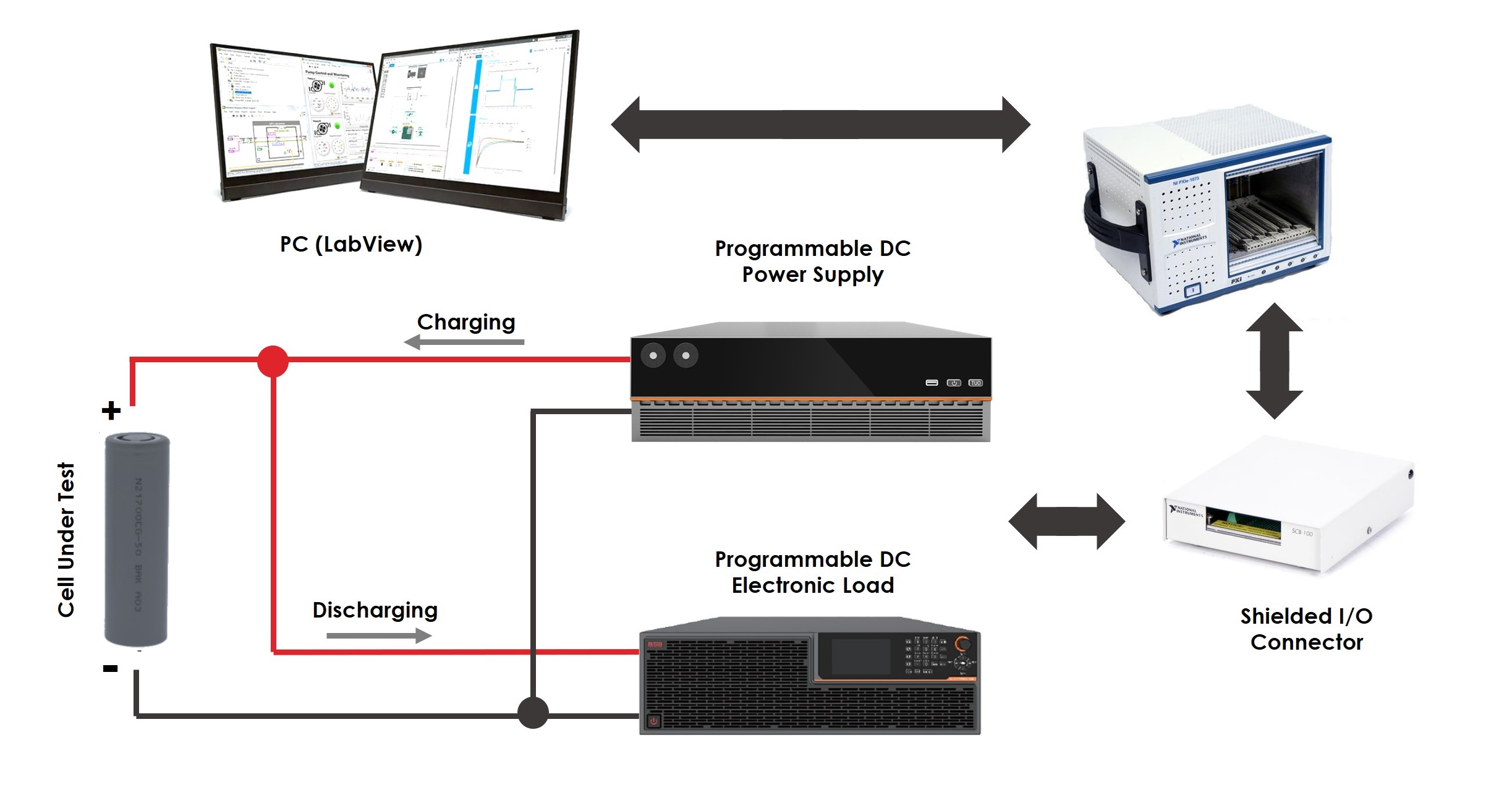
Battery Cycling Test Topology – Credit: ActionPower ATE
To explain in some short words, the cycling testing involves repeated charging and discharging processes under different usage pattern [3] and data logging after each cycle to monitor how the battery’s performance parameters vary or are affected. The test continues repetitively and call its completion until when the battery undergoes so many cycles that it reaches the target limit with a specific degradation under its rated performance. The number of charge-discharge cycles undergone to reach this status is referred to as the cycle life of the battery, but somehow nothing a precise definition yet depends on what would be the deemed acceptable level of degradation, generally when the capacity is below 80% of its original rated capacity.

Battery Cycling Test Sequences – Credit: ActionPower ATE
The fundamental to battery cycling test’s feasibility lies in the electrochemical reaction mechanisms within the battery.
Taking a lithium-ion battery for example, during charging, an externally applied voltage drives lithium ions to deintercalate from the positive electrode material and migrate through the electrolyte and separator to the negative electrode, where they intercalate into graphite or other negative electrode materials. [4]
During discharge, this process reverses, releasing stored energy to power an external load.
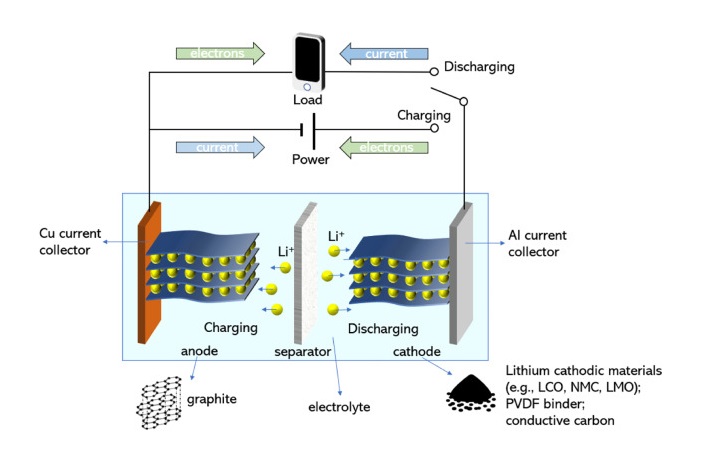
The validation of various battery performances is fundamentally achieved through the process of charge and discharge, which represents the most basic working principle underlying all testing and verification.
Battery’s capacity may vary when it is discharged under different C-rates meanwhile that the higher the c-rate for discharging is the more susceptible battery is to ageing and deterioration.
To evaluate the capacity of a battery pack, for example, a programmable charge–discharge testing system (ATE) is employed which performs controlled charge and discharge cycles under defined capacity rates (C-rates) and voltage limits, while continuously monitoring voltage, current, and time. By integrating the discharge current over time from the initial voltage down to the specified cut-off voltage, the effective capacity of the pack can be calculated in ampere-hours (Ah). For accurate and repeatable results, the testing system ensures stable current regulation, precise voltage cut-off control, and temperature monitoring. Such automated capacity testing not only determines the usable energy content of the battery pack under different operating conditions, but also provides essential data for lifetime prediction, safety assessment, and compliance with industry standards.
Cycle life is a key parameter of a battery, closely linked to its overall service life. IEC standards specify certain requirements that the capacity of the battery should remain above 60% of the initial value after 500 cycles.

An exemplar diagram showing assumed battery products under life cycle test
In an actual testing scenario, cycle life of a battery pack is evaluated by repeatedly charging and discharging it with an ATE system under set C-rates, temperatures, and cut-off voltages. Each full cycle is recorded for capacity, and the retention over hundreds of cycles reveals degradation such as resistance growth and capacity loss.
Looking for the right testing equipment to validate your batteries? Talk to ActionPower to explore our full range of power supplies and ATE for charge-discharge testing, cycle life testing solutions, and advanced simulation platforms. From EV packs to energy storage systems, we deliver tailored solutions to meet your testing needs.

BTS is a high-precision, modular battery cycler automated testing system covering the lifecycle and cycling test for traction battery pack testing for EV and battery pack for ESS applications.

From ActionPower we are open to listening to your suggestions and opinions.
For further media contact or consultation about any topics which might be of your interest about our company, you will be welcomed to send us an email to:
info@actionpowertest.com

Dynamics and power regeneration are no longer compromise to each other. Adopting innovation topology technologies is the PRL DC Load Simulator that accommodates ultra-fast dynamics, regenerative load and high-power scalability from a united single system.

The latest hybrid programmable power supply by ActionPower comes with 6 channels hybrid interface and allows AC/DC module arbitrary combination for flexible testing configuration where both AC and DC are...

Zhiwei Bao holds 20+ patents in the field of mechanical engineering and is keen on industrial automation and product marketing. His interdisciplinary background, along with his passion and initiative for learning, has led him to a profound understanding of power electronics. He manages the technical copywriting for programmable power and testing topics at ActionPower through product-marketing-driven approaches.
About Zhiwei Bao
If you are looking for an automated test system to validate your products during development and research stages to make sure of their successful commercial launch, ACTIONPOWER will be at your disposal to study your specifications and requirements to provided either standard or customized testing solutions.
Specification-matching testing and simulation solutions need discussion of both parties. Actionpower welcomes you inquirt to study together with us about how we can automate your testing processes.
Send InquiryThese are the upcoming events and places you can find ACTIONPOWER and talk with us face-to-face!
Check EventsAccess our Power Supply Wizard to find the right programmable power supply for your use cases and testing scenarios.

Professionalism is what we care about. Why not email us with your technical requirements fully explained rather than submitting a simple message so that we revert more proactively with detailed solutions?