Discover ActionPower's experience in the field of power electronics throughout 30 years of growth and successful track of industrial solutions.

Explore ActionPower's comprehensive range of programmable power and automated testing equipment covering AC/DC, profile emulation and testing sequence automation.

ActionPower combines our advanced programmable power with sophisticated softwares for diverse profile emulation solutions as well as versatile functioning realization.

ActionPower supports technological advancement for our users from various industries with flexible, sophisticated and multi-functional programmable power systems and profile emulation solutions.


Find out the latest innovations from ActionPower
Serving as the backbone of countless kinds of devices or equipment, batteries are fuelling the transformation of various industries and especially with the case of electric vehicles where combustion is being replaced by electricity.
While batteries are designed to facilitate effectively their maintenance, repairing and optimizing the process of power sourcing and sinking, their structural composition follows a certain level starts from cells to modules and packs. Understanding their roles in making up a battery and their differences can be helpful whether you own an electric vehicle or that you are just looking for some information for curiosity only, or probably that you are looking for a battery testing equipment like those PSUs and ATEs manufactured by ActionPower.
This article will provide with you a intelligible explanation to the distinctions between battery cells, modules, and packs and to equip you with the knowledge to identify and work with these basic battery elements with confidence.
<

To review a battery’s structure from a macro-view as a whole pack until the smallest units, which are referred to as battery cells, batteries are by no means a simple stack of cells to form modules and then as a pack yet follow a certain pattern to make up a system together with a BMS to manage the process of power sinking and sourcing.
The fundamental elements of a battery are battery cells, the production of which has more to do with chemicals and processing now that they are the basic unit where electrical energy is supposed to be stored as much as possible.

To review its structure more specifically, a battery cell can be further disassembled into the following components:
While a single battery cell is limited in its voltages and capacities that are insufficient for proper application, it is then necessary to group together cells into battery modules to reach the purpose. Grouping cells into modules can be done by arranging them in series and/or parallel, while which one exactly to opt for is voltage and capacity dependent.
Series Connection: Series connection is ideal for increasing and reaching expected voltage output, for example, a single 3.7V battery cell when connected in series as triple can reach to be an 11.1V module as a commonly seen option in various devices such as for electric vehicles.
Parallel Connection: When it is supposed to increase overall capacity while maintain the voltage as the same, parallel connection is then the option to consider.
The configuration of these cells within the module is designed to match the needs of the application, whether it is for higher voltage (like in electric vehicles) or for large storage capacities (such as in energy storage systems). Proper balancing and thermal management are also crucial at the module level to ensure safety and longevity.

Battery modules are grouped and assembled further into packs together with more control software, device and system to form a systematical function unit for sink and source power for certain applications with more complex requirements, power and capacity needs as well as to monitor its status and performance during charging and discharging power.
Battery Management System (BMS): The battery management system (BMS) serves to control the battery pack’s continuous status of voltage, temperature and various dynamic status and achieve charge balance between all cells thus to ensure the safe limits during operation. BMS serves not only to prevent damage yet also to maximize the battery’s lifespan and performance.

Battery Management System
Credit: SRMTech
Thermal Management System: Batteries generate heat during both charging and discharging processes. To maintain safe operating temperatures, effective thermal management systems, such as liquid cooling or passive air cooling, are employed to keep the battery pack within safe temperature limits.
Safety Systems: Protection circuits are integrated into the battery pack to prevent overcharging, over-discharging, short circuits, and other hazardous conditions. These safety mechanisms are critical in preventing thermal runaway or fires, ensuring the pack operates safely under all conditions.
By combining multiple modules and integrating these advanced systems, the battery pack offers the required energy storage and power output for demanding applications, including electric vehicles and large-scale energy storage systems.
The mechanical composition from cells to modules and packs forms a systematical structure to efficiently sink (store) and source (discharge) power through their coordinated efforts.
During charging, the battery sinks power by accepting energy from the power source, while during discharging it sources power by releasing energy to the load or the external circuit. The whole process is managed together by the BMS to control the flow of energy, monitor voltage levels, and adjust the current to ensure the battery operates efficiently within the specified parameters.
Sink and source characteristics, depending on which industry the battery is used, is supposed to meet and comply with certain standards and regulations for safety concerns. Examples is IEC 62620:2014 that focuses on the performance aspects of secondary lithium cells and batteries used in industrial applications, which specifies:
and apart from which the European Commission has more specific requirements for certain applications such as for EVs and ESS, including
Teams from ActionPower are at your disposal to provide comprehensive, high-precision battery testing solutions to support your battery component validating from individual cells to fully integrated battery packs or to offer battery simulation solutions to in turn test your battery-connected devices’ reliability and regulatory compliance confronting dynamic operating status and power feeding from batteries as if in real-world scenarios.
Click the following tabs to find more solutions or options of PSUs and/or automated test systems for batteries

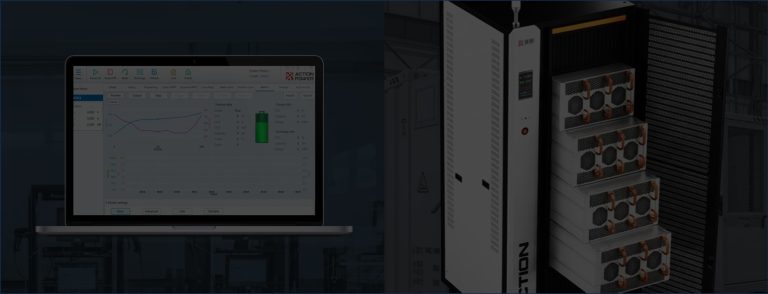
CORTEX series are Bidirectional DC Power Supplies that can source and sink power to charge and discharge batteries under test meanwhile that the discharge is regenerative. The built-in sophisticated program allows charging battery in dynamic situation to verify its functional characteristics – ideal for testing EV batteries under static/dynamic operating conditions.

Power conversion efficiency testing includes the simulation of battery connecting with other devices for sinking and sourcing power. ActionPower’s multi-functional software is capable of simulating either lead-acid or lithium-ion batteries during dynamic charge and discharge conditions with precisely replicated electrical and chemical characteristics or of verifying MPPT efficiency of solar inverter or PCS, which are battery-connected devices.

From ActionPower we are open to listening to your suggestions and opinions.
For further media contact or consultation about any topics which might be of your interest about our company, you will be welcomed to send us an email to:
info@actionpowertest.com

Dynamics and power regeneration are no longer compromise to each other. Adopting innovation topology technologies is the PRL DC Load Simulator that accommodates ultra-fast dynamics, regenerative load and high-power scalability from a united single system.

The latest hybrid programmable power supply by ActionPower comes with 6 channels hybrid interface and allows AC/DC module arbitrary combination for flexible testing configuration where both AC and DC are...

Zhiwei Bao holds 20+ patents in the field of mechanical engineering and is keen on industrial automation and product marketing. His interdisciplinary background, along with his passion and initiative for learning, has led him to a profound understanding of power electronics. He manages the technical copywriting for programmable power and testing topics at ActionPower through product-marketing-driven approaches.
About Zhiwei Bao
If you are looking for an automated test system to validate your products during development and research stages to make sure of their successful commercial launch, ACTIONPOWER will be at your disposal to study your specifications and requirements to provided either standard or customized testing solutions.
Specification-matching testing and simulation solutions need discussion of both parties. Actionpower welcomes you inquirt to study together with us about how we can automate your testing processes.
Send InquiryThese are the upcoming events and places you can find ACTIONPOWER and talk with us face-to-face!
Check EventsAccess our Power Supply Wizard to find the right programmable power supply for your use cases and testing scenarios.

Professionalism is what we care about. Why not email us with your technical requirements fully explained rather than submitting a simple message so that we revert more proactively with detailed solutions?