
Application Use Feb 17, 2026
How to Test String Inverter with High-Power SAS Power Supply and Grid Simulator?
The string inverter is the core conversion unit that bridges PV strings and the utility grid. It converts...
Discover ActionPower's experience in the field of power electronics throughout 30 years of growth and successful track of industrial solutions.

Explore ActionPower's comprehensive range of programmable power and automated testing equipment covering AC/DC, profile emulation and testing sequence automation.

ActionPower combines our advanced programmable power with sophisticated softwares for diverse profile emulation solutions as well as versatile functioning realization.

ActionPower supports technological advancement for our users from various industries with flexible, sophisticated and multi-functional programmable power systems and profile emulation solutions.


The conventional data center relying on a 48V architecture - where power shelves and racks operate at 54 VDC to compensate for voltage drops - is not yet a legacy, but remains a mature option for standard server generations. Within this low-voltage architecture, GPU clusters are supported by power shelves equipped with hot-swappable power modules (handling either AC-DC or DC-DC conversion), with total shelf capacities typically ranging from 15kW to 33kW.
However, as LLM training and real-world workloads scale exponentially, this low-voltage architecture struggles to keep pace. The surging power demand results in an unrealistically high current draw. Delivering such immense power at 54V can generate thousands of amps per rack, thus the required size and weight of copper busbars and cabling are physically and economically impractical.

The advent of HVDC power architecture has thus emerged to resolve the contradiction between the surging server workloads that reach beyond 1MW per rack and the physical limitations of copper busbars and cabling. By converting AC to 800 VDC and routing it directly to the servers, this architecture reduces the number of power conversion stages.
Consequently, data centers avoid the unrealistic hardware costs associated with handling massive 1MW workloads at 48V, while significantly improving overall energy efficiency by minimizing power conversion losses.

Programmable power testing for AI server has its focuses around validating whether the power distribution and subsystem can function stable, reliable and resilient against the AI server workload featuring shifting, volatile, unpredictable, and ultra-heavy current draw profile.
Programmable power, or to be more specifically the DC load simulator for such testing applications to replicate the server workload, sees inevitably the below requirements and functional features to achieve and comply with:
Replicating volatile power profiles and validating PDN resilience
Real-world AI server workloads exhibit unpredictably volatile power profiles with dramatic shifts in current draw. Consequently, for the electronic DC loads drawing current from the PSU, a high and fast slew rate, defined by di/dt, is a functional imperative. This is crucial for accurately replicating server workloads and validating the resilience of the Power Delivery Network (PDN).
Scaling programmable DC loads via master-slave architecture for MW testing
Even if building a physical 1MW AI rack solely for power testing is theoretically possible, replicating precise GPU workload functions remains a software challenge, and the hardware cost is prohibitive. Programmable DC loads, therefore, must be capable of being parallelled in a master-slave architecture to reach megawatt-level power, all while maintaining minimal accumulated latency and tight synchronization.
Utilizing regenerative loads to recycle energy and reduce thermal stress
Dissipating megawatt-level power as pure heat overwhelms laboratory cooling capacities and drives up electricity costs exponentially. Therefore, regenerative electronic loads - which recycle over 90% of the absorbed energy back to the grid - are now a strict necessity. To further manage extreme power densities, the testing instruments themselves may even increasingly migrate to liquid-cooled architectures, technically challenging for now though, and most probably in the near future.

Engineered for modern AI data centers, the PRL Series combines ultra-fast linear load dynamics (≤6μs response, up to 60 A/μs slew rate) with regenerative efficiency (recycling up to 87.1% of power to the grid). It is the ultimate testing ecosystem for both 50V/54V compute nodes and 800V/1000V HVDC architectures.
A single 25kW, 5U PRL chassis serves as the foundational building block that delivers the core operating capabilities and technical features required to construct a megawatt-level AI workload simulator.

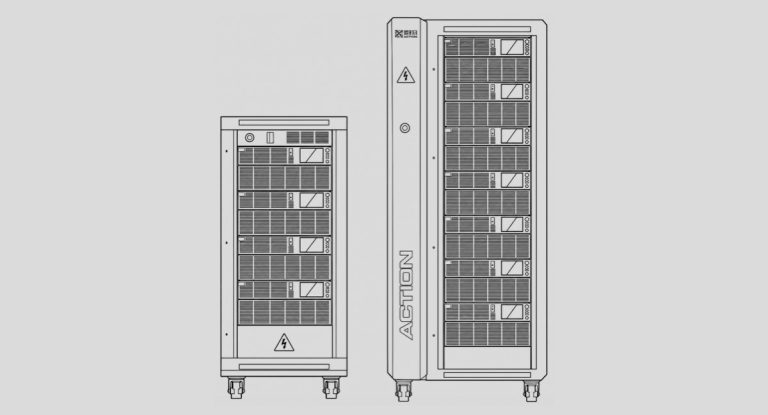
The PRL series features a highly scalable architecture. Up to seven 5U units can be paralleled within a modular cabinet system to deliver 175kW of power from a single platform.

Taking advantage of ActionPower's patented master-slave parallel technology, up to 8 fully loaded cabinets can be connected to build a massive 1.4MW AI server workload simulation platform.

Specification-matching testing and simulation solutions need discussion of both parties. Actionpower welcomes you inquiry to study together with us about how we can automate your testing processes.
Send InquiryThese are the upcoming events and places you can find ACTIONPOWER and talk with us face-to-face!
Check EventsAccess our Power Supply Wizard to find the right programmable power supply for your use cases and testing scenarios.

Professionalism is what we care about. Why not email us with your technical requirements fully explained rather than submitting a simple message so that we revert more proactively with detailed solutions?