Unifying High-Speed Linear Dynamics with High-Efficiency Energy Regeneration
The ActionPower PRL Series DC Load Simulator combines microsecond-level transient dynamics with high-efficiency energy recycling for regenerative testing.
Check the SystemDiscover ActionPower's experience in the field of power electronics throughout 30 years of growth and successful track of industrial solutions.

Explore ActionPower's comprehensive range of programmable power and automated testing equipment covering AC/DC, profile emulation and testing sequence automation.

ActionPower combines our advanced programmable power with sophisticated softwares for diverse profile emulation solutions as well as versatile functioning realization.

ActionPower supports technological advancement for our users from various industries with flexible, sophisticated and multi-functional programmable power systems and profile emulation solutions.


AI infrastructures built for handling and supporting the workload forced by AI servers and their GPUs clusters typically confront the challenges of extremely volatile and unpredictable power characteristics, with an uncomparable consumption of hundreds of megawatt-hours of electricity in contrast to that of conventional data centers.
Training Large Language Models (LLMs) requires an intensively high-power workload due to the exponential scale of model parameters, the massive volume of training data, and the hardware-heavy nature of iterative mathematical computations.
Unpredictable user query inflows cause spiky, volatile workloads for AI servers. This fluctuation makes resource allocation difficult, leads to rapid power and heat swings, increases latency during sudden peaks, and drives up overall data center operating costs.
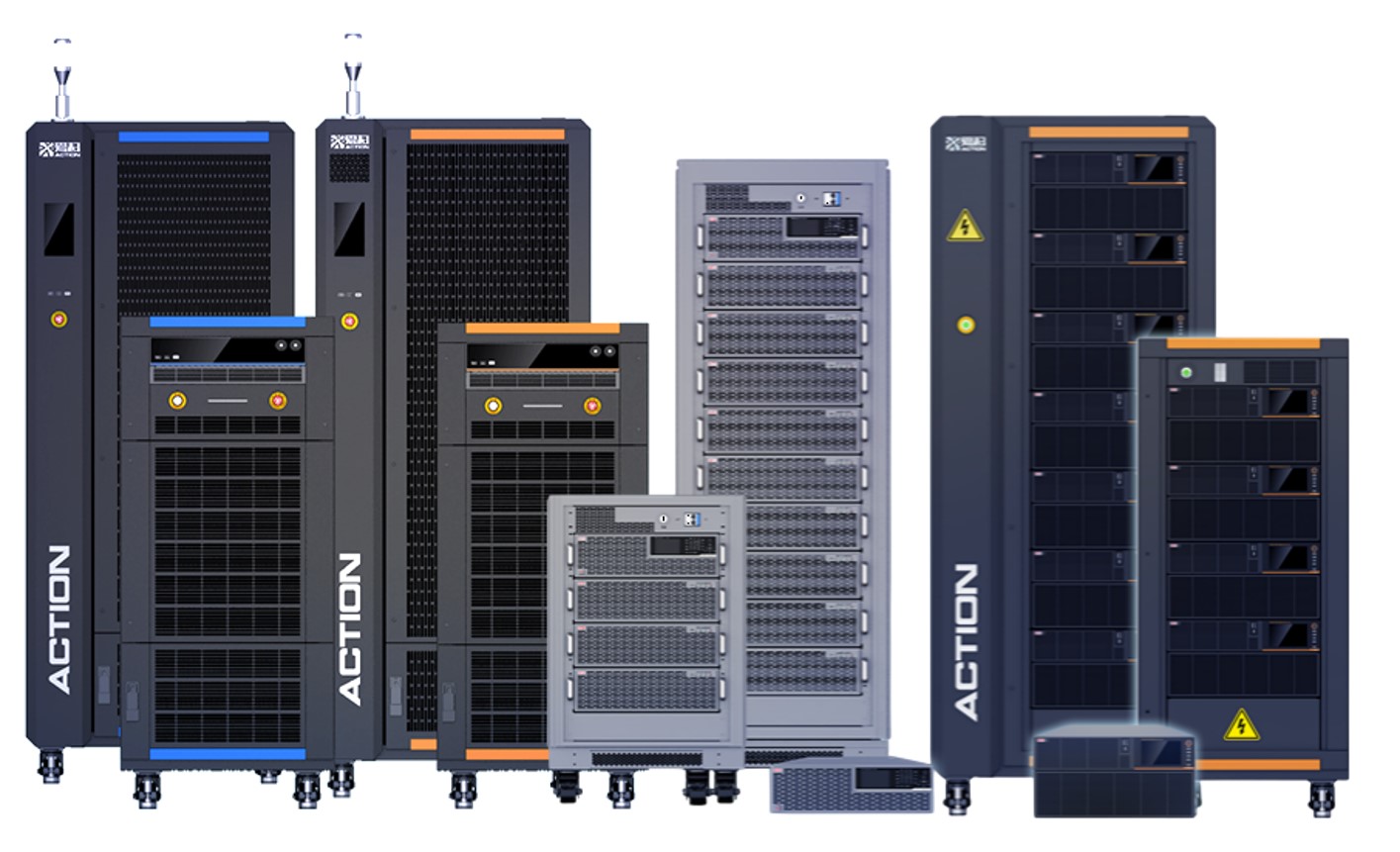
AI infrastructure that supports the GPUs cluster is not a one-way system. Nevertheless, various stages and facilities along the infrastructure are aligned and integrated to operate with each other for the smooth systematical operation. Power travels through a complex chain from grid to busbar and power supply and then through the VRMs to finally drive GPUs. If any single link among such a chain is not sufficiently robust, the dynamic current draw of GPUs will break the system.
To quantitatively and qualitatively evaluate the surrounding and upstream facilities and devices' robustness, EDPP (Electrical Data Peak Processing) applies and acts as the contract as well as benchmarking that every single component along the same must align with.
EDPP as the abbreviation of Electrical Data Peak Processing defines the maximum input current the graphic systems may draw from the infrastructure's power sources [Aetina, Source]. Despite that EDPP is not an international regulatory law of testing or certification (such as CE or UL safety certifications), the framework, as introduced by NVIDIA, has turned out to be well-accepted and crucial design and testing standards for modern AI data cetner industry. EDPP testing framework is bound up with 4 distinct parameters.

Source robustness testing as a variant of EDPP is intended for validating upstream power delivery network, primarily the Power Supply Unit (PSU) and the Voltage Regulator Modules (VRMs) on the motherboard or graphics card.
The DC load simulator replicates artificially the transient power spikes which often pull multiplied power rating for microseconds to milliseconds for testing whether there would be a voltage to drop (droop) below safe ATX or PCIe specifications or whether the spikes trigger the PSU’s internal safety mechanisms, such as Over Current Protection (OCP) or Over Power Protection (OPP).
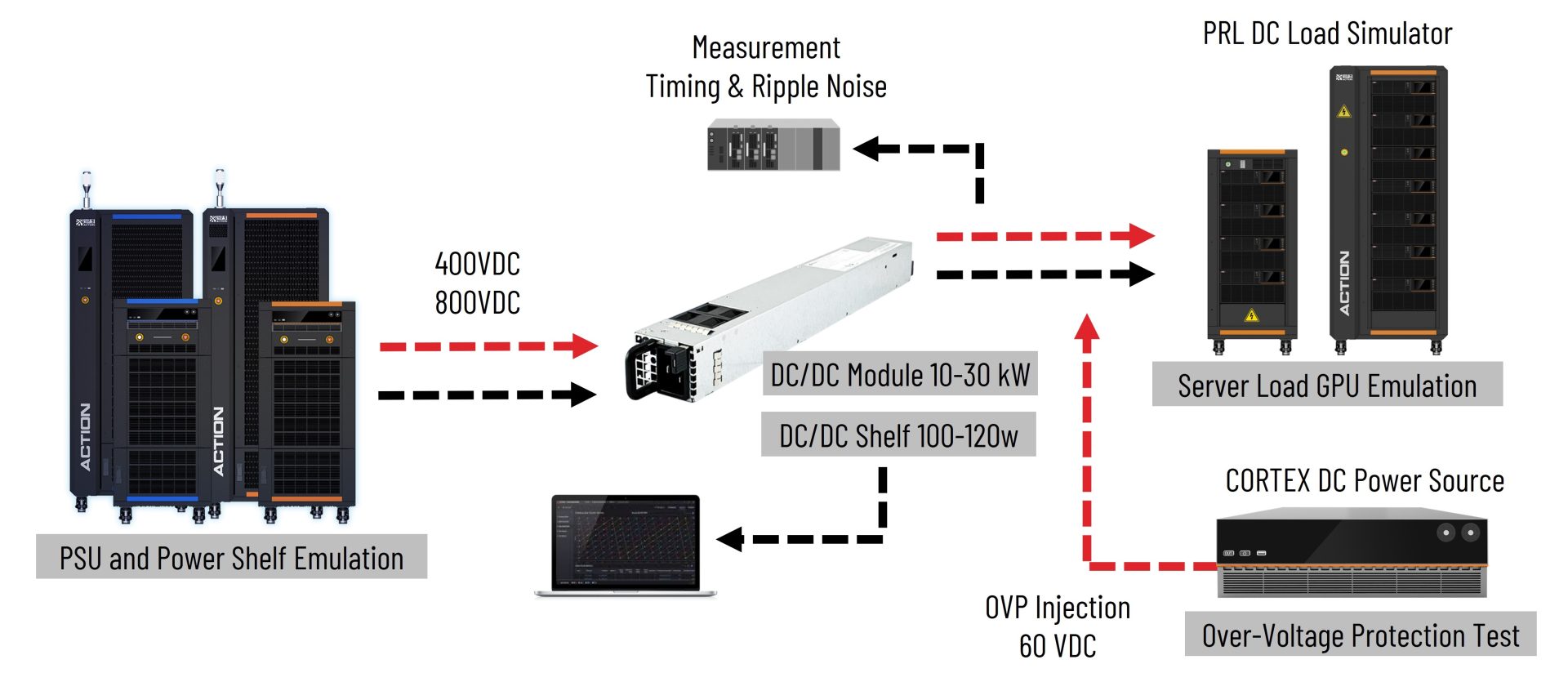
A GPU's power limit capability is validated with the same operating as the EUT in coordination with a programmable power source that simulates the power infrastructure. Test engineers and developers, by injecting software provoked load profiles that drives the GPU's current draw, validates whether the GPU can effectively monitor its own power draw and react fast enough to stay within its designated EDPP boundaries.


Specification-matching testing and simulation solutions need discussion of both parties. Actionpower welcomes you inquiry to study together with us about how we can automate your testing processes.
Send InquiryThese are the upcoming events and places you can find ACTIONPOWER and talk with us face-to-face!
Check EventsAccess our Power Supply Wizard to find the right programmable power supply for your use cases and testing scenarios.

Professionalism is what we care about. Why not email us with your technical requirements fully explained rather than submitting a simple message so that we revert more proactively with detailed solutions?