Discover ActionPower's experience in the field of power electronics throughout 30 years of growth and successful track of industrial solutions.

Explore ActionPower's comprehensive range of programmable power and automated testing equipment covering AC/DC, profile emulation and testing sequence automation.

ActionPower combines our advanced programmable power with sophisticated softwares for diverse profile emulation solutions as well as versatile functioning realization.

ActionPower supports technological advancement for our users from various industries with flexible, sophisticated and multi-functional programmable power systems and profile emulation solutions.


Find out the latest innovations from ActionPower
SMonitoring the state of energy battery on an electric vehicle is a constant task throughout it s lifecycle, as well as for temporary tracking during repetitive charging and discharging actions that will happen frequently during its use. Handling these tasks of constant and consistent evaluation of battery is the battery management system (BMS) that is always incorporated to accompany a battery in use for EVs.
What come with the most priority among the metrics for assessing the status of battery include State-of-Charge (SOC) and State-of-Health (SOH). The present article will spell out these critical parameters for a EV battery’s operation, define their values and use.
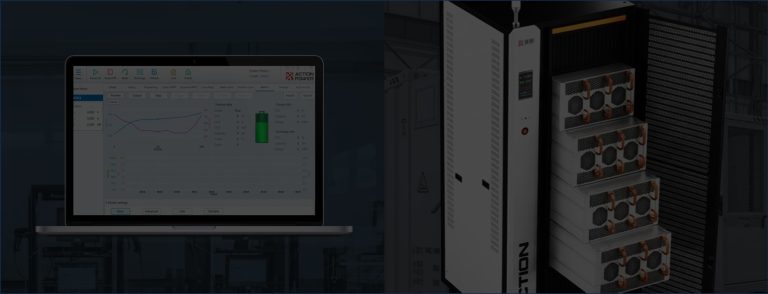
ActionPower partners with EV and energy battery manufacturers worldwide to support their R+D and innovation for advanced batteries with our power HIL solutions, as well as ATEs for end-of-line validation. Battery simulation power testing solutions by ActionPower incorporate accurate functions to emulate operation characteristics virtually and precisely with combined SOC & SOH status for validating battery reaction dynamically and supporting your algorithm optimization to drive ahead your development and innovation.

You might also be interested in our EV Charger Test Solutions? Visit this page for more information
State-of-Charge (SOC) represents one of the critical parameters when it comes to software applications of Battery Management System (BMS) in the field of power battery management’s academic research and highly relevant to industrial practice when they are actually put into use by consumers and end-users.
The essentialness of precise SOC estimation is unquestionably essential. Those with actual EV driving experience would inevitably bump into situations where they are driving on a highway heading for a charging station 300 km away, yet they would not be able to reach there and inevitably get the car stranded 30 km away from the station and to be towed, despite the displayed “remaining range” of 350 KM displayed on the center console when departure.
Apart from “Range Anxiety” caused by deviation in SOC, the potential risks of significant error in SOC estimated sees the possibility of over-charging or over-discharging that will lead to security issues during use.
The question lies here is that: what it can be done to tackle it issues of range anxiety and achieve better battery status estimation?
“State of charge (SOC): Ratio of the available capacity of a RESS or its subsystem to its rated capacity, expressed as a percentage.” – Click here to read the regulation

State-of-Charger (SOC) is associated with the remaining quantity of electricity available in the batter’s cell assessed by the difference between an ideally fully charged battery and the same one in use like during driving or charging process. [1]
To proceed with the equation for SOC calculation, we firstly define the following values to represent charging or discharging actions and the status of battery:
The equation for calculating SOC of a bettery is then defined as:
Improving SOC accuracy has been a continuing industrial challenge confronting major concerns around EV battery including Range Anxiety from user’s perspective and charging efficiency that matters either for EV manufacturers to
While State-of-Charge (SOC) assesses more than temporary and actual status of a battery, State-of-Health (SOH) focus rather the status of battery chronically to evaluate its lifespan and ageing progress as well its charging reliability.
SOH is primarily assessed through two key dimensions:
Capacity Fade – Reduction in usable energy storage compared to the original rated capacity (the above )
Internal Resistance Increase – Degradation in charge/discharge efficiency due to electrochemical ageing.
The most common way to define SOC is by calculating the ratio of the battery’s current status of maximum charging to its rated capacity, expressed as the following equation and referred to as Capacity Fade:
While for SOH estimation based on internation resistance increase, the equotion will in turn be defined as:
While the more unified expression of equation we mentioned in previous chapter provides a clear and fundamental definition of SOC, its practical estimation in real-world situation combined with Battery Management System (BMS) will rely further on more application-specific methods, among which, the primary 2 approaches are Coulomb Counting and the Open-Circuit Voltage (OCV) method. Each comes with distinct advantages and limitations, and understanding them is essential for both system designers and test engineers.
Coulomb Counting is the most straightforward method to estimate SOC in real-world practice that works by integrating the charge or discharge current over time to track how much energy has been put into or drawn from the battery.
The general formula is:
Despite the common application of Columb Counting due to its simplicity and responsiveness, however, it comes with notable drawbacks including:
Real-world practice would not exclusively rely on Coulomb Counting yet often get it combined with other methods (e.g., model-based estimation or OCV correction) to maintain long-term accuracy.
The OCV method estimates SOC by mapping the battery’s terminal voltage — after it has rested sufficiently — to a known OCV-SOC characteristic curve. This approach assumes a quasi-static relationship between SOC and voltage, which holds when the battery is at equilibrium.
Different battery chemistries exhibit different OCV-SOC profiles:
Despite its accuracy under static conditions, the OCV method requires several hours of rest time (typically ≥2 hours) for the voltage to stabilize. This makes it impractical for dynamic real-time applications like electric vehicles in operation.
No matter how advanced an SOC estimation algorithm is — whether it’s Coulomb Counting, OCV-based, or model-driven — its performance must be validated across real-world conditions against dynamic driving and load profiles, temperature variations and the inevitable cell ageing regardless of battery’s chemistries. Without rigorous testing, estimation drift, safety risks, and performance degradation may remain undetected until late-stage deployment.
ActionPower stands in there to provide specialized BMS testing systems and programmable power supplies to support your R&D calibration and end-of-line production testing. Implementing, for example, a BMS power-HIL testing system will benefit both your R+D+I and end-of-line test by assessing the algorithm accuracy, charge/discharge protection logic, cell balancing behavior as well as it response to fault injection and emulation real-time anomalies.

For more information you would also interested in some PSUs and ATE among our category:
With high accuracy, low ripple, and fast response time, ActionPower systems help engineers perform closed-loop validation of SOC/SOH estimation models, calibrate protection thresholds, and evaluate balancing strategies across temperature and load variations.

From ActionPower we are open to listening to your suggestions and opinions.
For further media contact or consultation about any topics which might be of your interest about our company, you will be welcomed to send us an email to:
info@actionpowertest.com

Dynamics and power regeneration are no longer compromise to each other. Adopting innovation topology technologies is the PRL DC Load Simulator that accommodates ultra-fast dynamics, regenerative load and high-power scalability from a united single system.

The latest hybrid programmable power supply by ActionPower comes with 6 channels hybrid interface and allows AC/DC module arbitrary combination for flexible testing configuration where both AC and DC are...

Zhiwei Bao holds 20+ patents in the field of mechanical engineering and is keen on industrial automation and product marketing. His interdisciplinary background, along with his passion and initiative for learning, has led him to a profound understanding of power electronics. He manages the technical copywriting for programmable power and testing topics at ActionPower through product-marketing-driven approaches.
About Zhiwei Bao
If you are looking for an automated test system to validate your products during development and research stages to make sure of their successful commercial launch, ACTIONPOWER will be at your disposal to study your specifications and requirements to provided either standard or customized testing solutions.
Specification-matching testing and simulation solutions need discussion of both parties. Actionpower welcomes you inquirt to study together with us about how we can automate your testing processes.
Send InquiryThese are the upcoming events and places you can find ACTIONPOWER and talk with us face-to-face!
Check EventsAccess our Power Supply Wizard to find the right programmable power supply for your use cases and testing scenarios.

Professionalism is what we care about. Why not email us with your technical requirements fully explained rather than submitting a simple message so that we revert more proactively with detailed solutions?