Discover ActionPower's experience in the field of power electronics throughout 30 years of growth and successful track of industrial solutions.

Explore ActionPower's comprehensive range of programmable power and automated testing equipment covering AC/DC, profile emulation and testing sequence automation.

ActionPower combines our advanced programmable power with sophisticated softwares for diverse profile emulation solutions as well as versatile functioning realization.

ActionPower supports technological advancement for our users from various industries with flexible, sophisticated and multi-functional programmable power systems and profile emulation solutions.


Find out the latest innovations from ActionPower
Less space and faster validation, more powerful testing capability, verifying more devices at one time. Testing and validation have the same envision either for R+D in laboratory or for production end-of-line and the most foundational expectation that lies behind is to achieve better productivity within a certain given area.
A conventional testing scenario may involve the implementation and deployment of a programmable power supply to drive electronic testing from a single AC input, then with the addition of an electronic load to connect the DUT’s output side, further accompanied by measurement instruments to build up a complete testing topology. Nevertheless, such an approach multiplies the complexity and gets the testing cost rocketed once when there are multiple sets of electronic devices engaged in the testing.
This article will clarify the features of multi-channel power supplies and further extend the topics to the latest new innovations of modular testing system that offers more advanced multi-channel testing applications.
Multi-channel power supply refers to a certain design of programmable and testing-purposed power supply that converters a single AC input and splits it into multiple channels whose output parameters such as voltage, current and power are separately and independently adjustable and controllable. Multi-channel power supplies are, in themselves, available for series or parallel connection between the channels to offer more flexibility of testing application.

Traditional Multi-Channel Testing Application
The primary advantages of multi-channel power supplies is achieving better space utilization and power density when it is applied for automated test equipment (ATE) racks where a ranges of devices are integrated to operate simultaneously for satisfying the device under test (DUT). In case of testing application where multiple voltage or power levels are required in sequential process steps, multi-channel power supplies outstrip the others. [1]
Being their primary advantage of space-saving, and depending on certain testing applications, multi-channel power supply may provide all the power outputs channels to a single unit under test thus to replace 3 sets of power source or to test 3 sets of devices simultaneously without the essentialness of connecting each one of them with a power supply.
Supposing a testing scenario where several battery cells are to be validated under controlled charge and discharge conditions, with each of them powered and monitored independently for verifying capability, cycle life and consistency across a batch.
The conventional approach would be sourcing each battery cell with a separate DC power source. However, using single-channel supplies for each cell quickly becomes impractical, as the number of instruments, wiring complexity, and data synchronization challenges increase.
A multi-channel test power supply solves this problem by integrating multiple programmable outputs within a single unit. Each channel can act as an independent source or sink, providing precise voltage and current control, while also recording performance data in parallel. This allows engineers to subject dozens of cells to identical or varied test profiles simultaneously, streamlining the evaluation process and improving statistical reliability. With synchronized operation, transient events and fault conditions can also be reproduced consistently across all channels, enabling faster validation of battery technologies for electric vehicles, energy storage, and portable electronics.
Validating CPUs and GPUs for data center applications requires precise control of multiple voltage domains and the ability to reproduce dynamic load conditions. Modern processors demand a 12 V high-current rail for core operation, alongside auxiliary rails such as 5 V for peripherals and lower rails like 1.8 V or 1.2 V for memory controllers and high-speed logic. Each rail must follow a strict power-up and sequencing profile to prevent latch-up or initialization failures.
A multi-channel test power supply enables engineers to program these rails simultaneously with independent voltage, current, and timing parameters, while central coordination ensures deterministic sequencing. In addition, advanced transient testing can be performed by introducing fast load steps to simulate sudden workload shifts, capturing voltage droop, recovery time, and overshoot behaviour with oscilloscope probes. This allows engineers to characterize the power integrity of CPUs and GPUs under conditions that closely mirror data center operation, ensuring stable performance and compliance with design specifications.
Traditional multi-channel power supplies have been acknowledged for their advantages of saving space and simplifying testing complexity though, they have certain limitations when the testing scenarios require further advanced features, for example, like bidirectional power flow and simultaneous AC and DC outputs or inputs. Some of these requirements would further complicate the wiring with more instruments needed for building up the test bench, or that they are in nature unachievable with the traditional multi-channel power supply.
The latest advancement and innovations with multi-channel power supplies strive to achieve more functionality and achieve to develop more powerful testing equipment. Some of the innovations are:

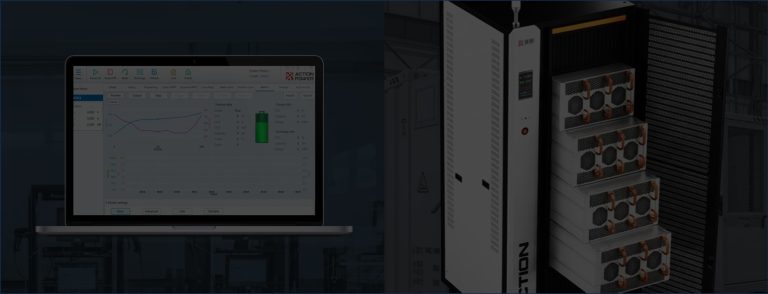
6-channel-based modular programmable power testing system that allows through 6 slots the arbitrary combination of AC and DC modules for either inputs or outputs to fit flexibly versatile testing applications.
“Helion” modular multi-channel power supply advances further beyond those conventional ones which are merely a certain form of source. “Hellion” offers a range of modules including bidirectional DC module, AC module, and PV simulation module which can be combined through 6 slots within the mainframe to build up testing topologies for different scenarios and applications.
Fast-removal and swap modules in minutes with auto-identification and instant channel remapping.

Mix DC, bidirectional/regenerative, and AC source modules to match evolving tests.

Six universal slots let you scale voltage/current and function, slot by slot.

Design your own test topology: multi-rail DC benches, AC+DC mixed rigs, or synchronized multi-channel profiles.

ActionPower, located in Xi’an, Shaan Xi of China, has been in the field of power electronics developing and manufacturing programmable power systems and automated testing equipment ever since 1996 and now with portfolios covering programming power supplies, electronic loads and advanced ATE systems. For further inquiries about your multi-channel testing projects, feel free to get in contact with our team by sending emails or submitting a contact form.

From ActionPower we are open to listening to your suggestions and opinions.
For further media contact or consultation about any topics which might be of your interest about our company, you will be welcomed to send us an email to:
info@actionpowertest.com

Dynamics and power regeneration are no longer compromise to each other. Adopting innovation topology technologies is the PRL DC Load Simulator that accommodates ultra-fast dynamics, regenerative load and high-power scalability from a united single system.

The latest hybrid programmable power supply by ActionPower comes with 6 channels hybrid interface and allows AC/DC module arbitrary combination for flexible testing configuration where both AC and DC are...

Zhiwei Bao holds 20+ patents in the field of mechanical engineering and is keen on industrial automation and product marketing. His interdisciplinary background, along with his passion and initiative for learning, has led him to a profound understanding of power electronics. He manages the technical copywriting for programmable power and testing topics at ActionPower through product-marketing-driven approaches.
About Zhiwei Bao
If you are looking for an automated test system to validate your products during development and research stages to make sure of their successful commercial launch, ACTIONPOWER will be at your disposal to study your specifications and requirements to provided either standard or customized testing solutions.
Specification-matching testing and simulation solutions need discussion of both parties. Actionpower welcomes you inquirt to study together with us about how we can automate your testing processes.
Send InquiryThese are the upcoming events and places you can find ACTIONPOWER and talk with us face-to-face!
Check EventsAccess our Power Supply Wizard to find the right programmable power supply for your use cases and testing scenarios.

Professionalism is what we care about. Why not email us with your technical requirements fully explained rather than submitting a simple message so that we revert more proactively with detailed solutions?