Discover ActionPower's experience in the field of power electronics throughout 30 years of growth and successful track of industrial solutions.

Explore ActionPower's comprehensive range of programmable power and automated testing equipment covering AC/DC, profile emulation and testing sequence automation.

ActionPower combines our advanced programmable power with sophisticated softwares for diverse profile emulation solutions as well as versatile functioning realization.

ActionPower supports technological advancement for our users from various industries with flexible, sophisticated and multi-functional programmable power systems and profile emulation solutions.


Find out the latest innovations from ActionPower
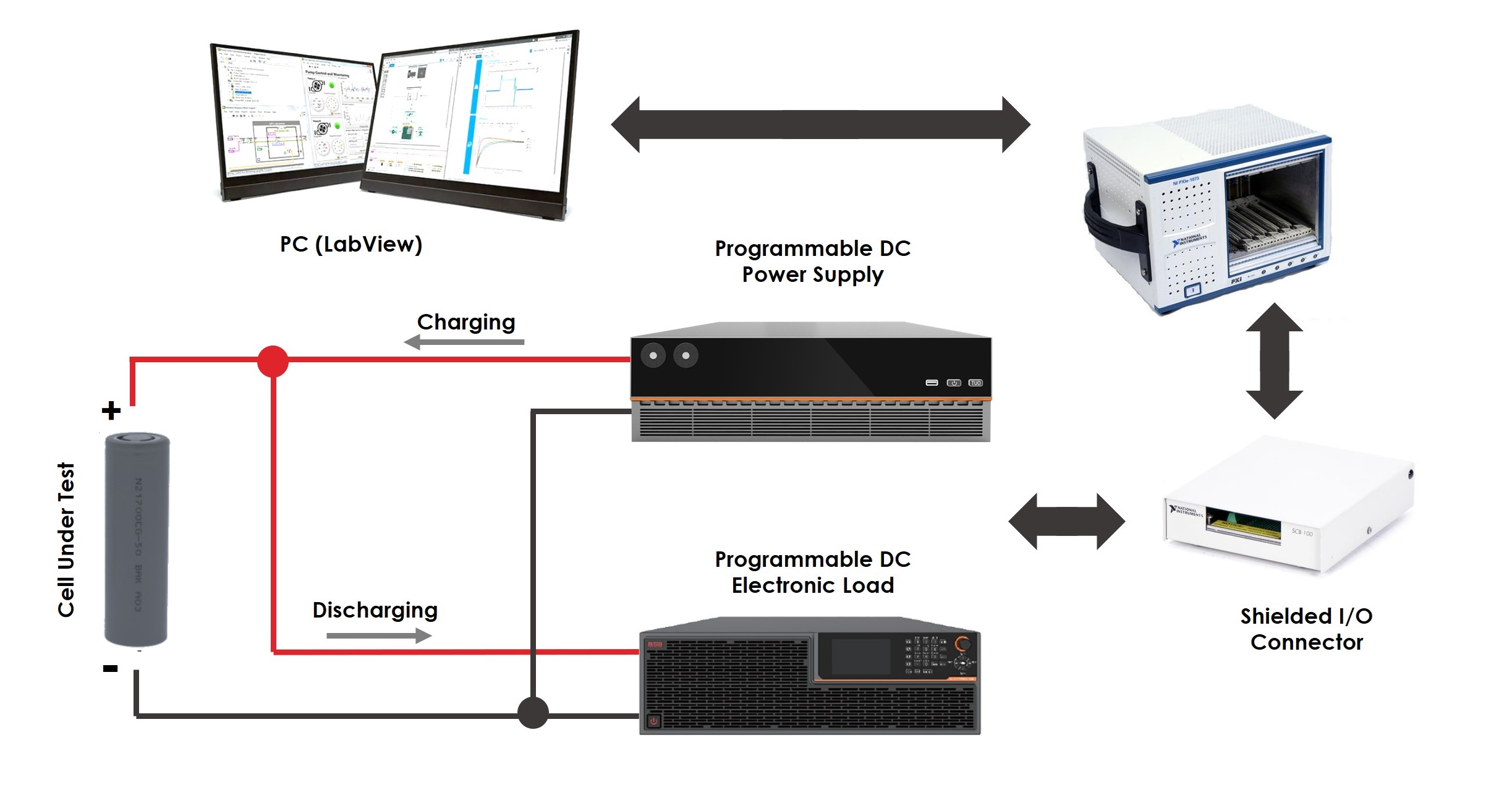
Power flow in testing system it not necessarily a “one-way game” that has no return, however, most of the modern and more recently designed testing power supplies come with the functions of both sinking and sourcing power, a pattern which can be imprecisely defined as “bidirectional“.
The driving force behind this evolvement is due in large part to the testing topology setup, for example, for a battery cell that should be both charged and discharged, for which the traditional setup requires both a DC power source and then an electronic DC load to fulfil such kind of power flow. The approach to sinking power has more concerns, nevertheless, sometimes that the unit should emulate a certain load pattern rather than simply consuming the power into heat, or in some cases due to extreme high voltage is required for power testing, the sunk power should be fed back to grid to save testing cost.
This article targets resolving the confusion and the ambiguity between the concepts of “bidirectional“, “load emulation” and “regenerative load“. Ask yourselves whether the following questions are among your concerns and if so, this article is right for you.
The term of electronic load refers to devices that serve as a programmed load that set certain restrains to the power sunk in the unit to verify against the power supply’s performance. To find more about how electronic loads work and they are programmed for operating under different loading patterns, check this page.
Power semiconductors like MOSFET and IGBT in the electronic load’s circuit consumes the power sunk and dissipate them into heat. Such features deem inherently that electronic loads are not ideal instrument for testing scenarios where the power flow is as high as, with a general perception, more than 1kW and beyond which more dissipation issues will call essential more advanced cooling approaches like by air or liquid.

Heat Dissipation and Management is one of the Downsides with E-Load
Credit: ActionPower ATE
Typical applications of programmable electronic loads may include but are not limited to the following ones:
Regenerative load or load regenerative may not necessarily refer to a unit with load capability that can be programmed for emulating different loading patterns yet it is primarily about the characteristics of feeding energy sunk from the DUT back to the AC utility grid.
The key edge load regenerative has over the consequence of heat dissipation with an electronic load are about the saving the energy cost and the technical foundation lied for enduring testing with high power output.
The grid-side control process ensures that absorbed DC-link energy is converted and injected back into the AC grid as clean, sinusoidal current by using PLL-based synchronization, a fast current loop, a slower outer DC-link regulation loop, and an LCL filter with damping for stability.

The term of bidirectional refers principally to the capability that a power supply can operate as both a programmable source as well as an electronic load to sink power, though in most of the cases modern bidirectional power supplies are also with regenerative load capability and cover all four quadrant functionally among the I-V curve.
In other words, a bidirectional supply may encompass functions associated with both electronic loads and regenerative loads, yet it should not be considered as a direct counterpart or simple substitute for either of the latter. However, while versatile, bidirectional power supplies acting as electronic loads may lack the dedicated precision, power range, specialized modes, and protection features of purpose-built electronic loads for demanding testing scenarios.
Bidirectional bench DC power supply CORTEX features high power density at 3U size with rack option to scale up to 3MW, with further advantages of regenerative load and load emulation capability.

| Approaches | Energy Path | Functions | Advantages | Limitations |
|---|---|---|---|---|
| Electronic Load | Dissipated | Load emulation | Flexible for smaller scale testing | High energy cost |
| Regenerative Load | Back to Grid | Load emulation with regeneration | Cost-saving, sustainable for high power testing | Requires grid connection |
| Bidirectional PSU | Dissipated / Back to Grid | Source and sink (often regenerative) | Combines advantages of source and load | Limited load simulation flexibility |
Still confused of distinguishing how these three approaches to loading and sinking power vary and no idea what kind of power supply may be the best option for you? We suggest write an email to ActionPower and we will study your testing requirements and revert with the best proposal and option of power supplies or electronic loads that exactly match your cases.
For better access our portfolio of power supplies and electronic loads, you may also check our on-page tool of power supply selector where you may filter on the basis of specifications and find the right instrument for your test.

From ActionPower we are open to listening to your suggestions and opinions.
For further media contact or consultation about any topics which might be of your interest about our company, you will be welcomed to send us an email to:
info@actionpowertest.com

Dynamics and power regeneration are no longer compromise to each other. Adopting innovation topology technologies is the PRL DC Load Simulator that accommodates ultra-fast dynamics, regenerative load and high-power scalability from a united single system.

The latest hybrid programmable power supply by ActionPower comes with 6 channels hybrid interface and allows AC/DC module arbitrary combination for flexible testing configuration where both AC and DC are...

Zhiwei Bao holds 20+ patents in the field of mechanical engineering and is keen on industrial automation and product marketing. His interdisciplinary background, along with his passion and initiative for learning, has led him to a profound understanding of power electronics. He manages the technical copywriting for programmable power and testing topics at ActionPower through product-marketing-driven approaches.
About Zhiwei Bao
If you are looking for an automated test system to validate your products during development and research stages to make sure of their successful commercial launch, ACTIONPOWER will be at your disposal to study your specifications and requirements to provided either standard or customized testing solutions.
Specification-matching testing and simulation solutions need discussion of both parties. Actionpower welcomes you inquirt to study together with us about how we can automate your testing processes.
Send InquiryThese are the upcoming events and places you can find ACTIONPOWER and talk with us face-to-face!
Check EventsAccess our Power Supply Wizard to find the right programmable power supply for your use cases and testing scenarios.

Professionalism is what we care about. Why not email us with your technical requirements fully explained rather than submitting a simple message so that we revert more proactively with detailed solutions?