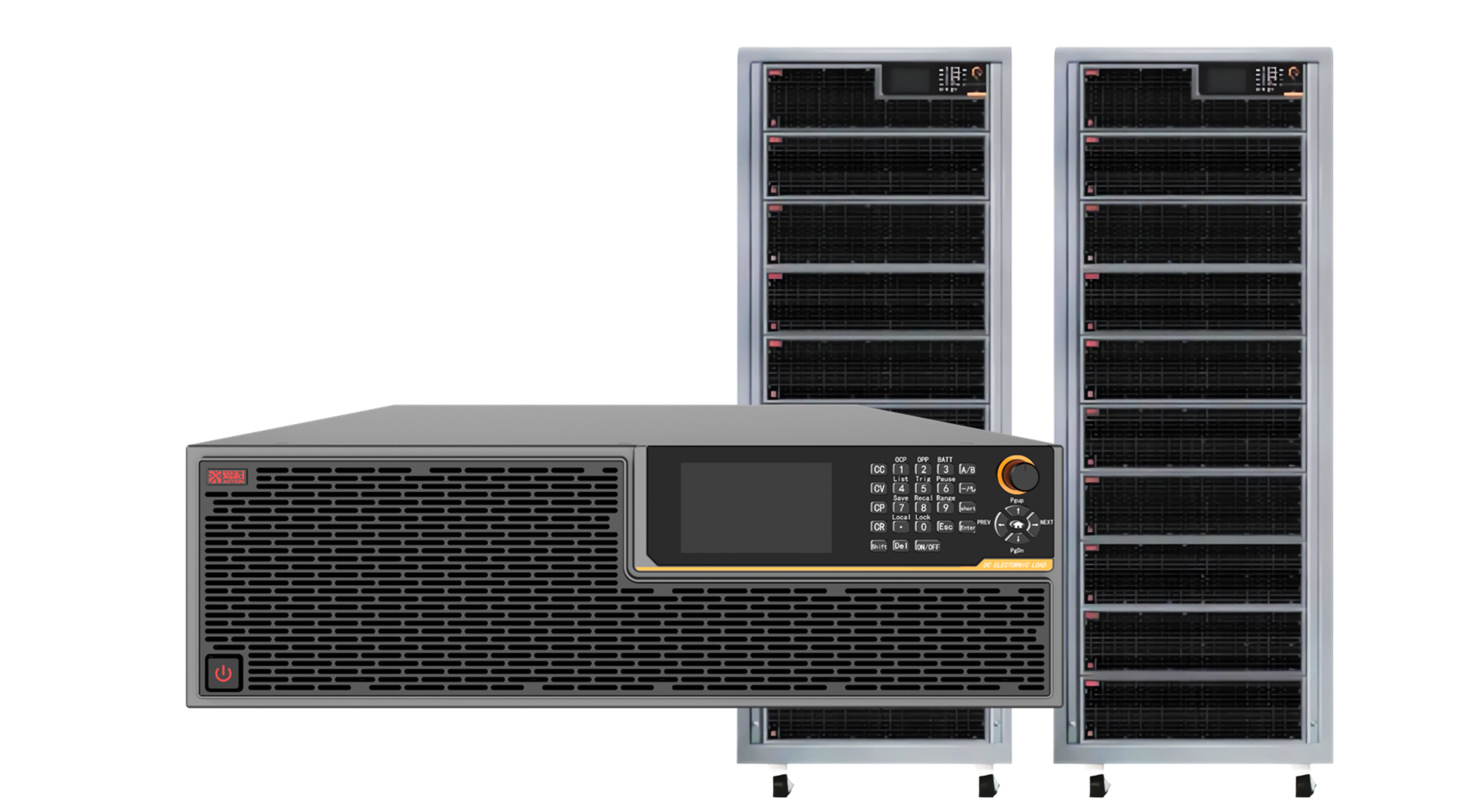
Rackmount Programmable AC Power Supply
6 kVA ~ 220 kVA, 0~779 V_rms
Flexible AC input emulation for UPS functional verification, utility condition reproduction, and front-end validation at rack and subsystem level.

Uninterruptible Power Supply (UPS) assumes the critical role of interfacing between the utility grid and the highly dynamic computing loads driven by GPU cluster, with Battery Backup Unit (BBU) standing in between as backup supply during grid outage. Positioning as the transition hub between supply and downstream IT equipment, UPS performs AC-DC-AC conversion while maintaining a stable power environment for servers despite grid disturbances or internal load fluctuations.
While GPT training tasks can generate rapid power transitions and peak demand, the UPS's capability of maintaining stability is beyond questioning. Apart from switching to backup energy through the battery subsystem, the UPS should offer consistent voltage stability and support seamless transfer between grid and battery operation, and tolerance to abnormal grid conditions such as voltage sags, frequency deviations, and harmonic distortion.
Programmable power and profile emulation solutions are thus indispensable for validating these capabilities. For instance,
In these scenarios, grid simulators, battery simulators, and high-performance electronic loads collectively form a controllable test environment that replicates real-world operating conditions. They are essential testing equipment and programmable power for validating UPS during development and prototype acceptance stage for laying the foundation of future trustworthy deployment in modern AI data center.
Setting up testing platform for validating UPS performance varies according to the purposes of verification and to what performance and reactions UPS should react against different scenarios.
Grid disturbance testing evaluates the ability of the UPS to maintain stable output under abnormal utility conditions.
A programmable grid simulator reproduces disturbances such as voltage sag, swell, frequency deviation, phase jump, and harmonic distortion according to standards such as IEC 61000-4-11 and IEC 61000-4-13. Key evaluation parameters include output voltage regulation, waveform distortion, and recovery performance during grid events.

Battery interaction testing verifies the coordination between the UPS power conversion stages and the connected energy storage system.
Test sequence setup requires hence a battery simulator which replicate diverse battery conditions such as state-of-charge variation, internal resistance, and dynamic charge–discharge behaviuor. The test focuses on DC-bus stability, bidirectional power flow control, and system response during transitions between rectifier and battery operation.

Dynamic load testing evaluates UPS transient response and output voltage stability under sudden load changes. A high-speed electronic load generates programmable load steps and transient profiles to emulate the rapid power fluctuations characteristic of AI server and GPU cluster workloads.

Powered by ActionPower's Advanced Profile Emulation Solutions
Specification-matching testing and simulation solutions need discussion of both parties. Actionpower welcomes you inquiry to study together with us about how we can automate your testing processes.
Send InquiryThese are the upcoming events and places you can find ACTIONPOWER and talk with us face-to-face!
Check EventsProfessionalism is what we care about. Why not email us with your technical requirements fully explained rather than submitting a simple message so that we revert more proactively with detailed solutions?