
Application Use Mar 13, 2026
How is Uninterruptible Power Supply Tested with Programmable Power?
Uninterruptible Power Supply (UPS) assumes the critical role of interfacing between the utility grid and the highly dynamic...
Discover ActionPower's experience in the field of power electronics throughout 30 years of growth and successful track of industrial solutions.

Explore ActionPower's comprehensive range of programmable power and automated testing equipment covering AC/DC, profile emulation and testing sequence automation.

ActionPower combines our advanced programmable power with sophisticated softwares for diverse profile emulation solutions as well as versatile functioning realization.

ActionPower supports technological advancement for our users from various industries with flexible, sophisticated and multi-functional programmable power systems and profile emulation solutions.


Modern grid landscape is no longer a centralized one-way system dominated by a single or regionally several power plants (typically fossil fuels or natural gas) but now decentralized with DERs (Distributed Energy Resources) through PCC (point of common coupling) to form a complexly interconnected network.
With testing framework and certifications standards including IEEE 1547.1-2020 and UL 1741 SA/SB providing the relevant conformance test procedures, Solar arrays, on-and-offshore wind turbines, and energy storage systems tied up to grid through PV inverters and PCS as DERs are expected to be resilient as when suffer from disturbance from the grid against which they should either enforce disconnection for safety concerns or maintain the interoperability for supporting the grid.

Regulations, testing procedure framework and certification standards around the world, either regional or international, including IEEE 1547, UL 1741 SA/SB, EN 50547 and GB/T, attach importance primarily to the functioning that inverters and power conversion systems (PCS) should withstand a complex series of weak grid conditions, provide grid supporting and detect islanding conditions against the most tricky Non-Detection Zone (NDZ).
Ensure safety compliance and validate active/passive islanding detection
While harmonics, flickers, DC injections are among the most common testing items of power quality validation, one test that overrides due to safety concerns is the islanding test for which the inverters should in accordance with IEEE and UL requirements to demonstrate its control logic and algorithm capability for both active and passive islanding.
Verify resilience under low SCR, SSO, and fault ride-through conditions
DERs-dominated grid is not as stable as it is supposed to be. Inverters and PCS should be proven against their resilience against the most unexpected weak grid conditions and stability under low SCR operation environments. Key testing items include SSO (Sub-Synchronous Oscillation), Fault Ride-Through Capabilities (LVRT/HVRT/ZVRT) along with dynamic Volt-Var and Frequency-Watt conditioning capabilities.
Execute seamless transitions and emulate inertia via VSG
Power Conversion Systems (PCS) are evolving from grid-following towards grid-forming ones with capability of forming regionally a micro-grid by emulating the inertia with the alogrithm of VSG (Virtual Synchronous Generation). PCS must execute, in the event of grid outage, a seamless transition between grid-tied and off-grid control modes within a stringent timeframe to ensure an uninterrupted power supply to critical loads.
ActionPower's grid simulators combines excellent performance specifications thanks to our patented hardware and circuit technology based of SiC, FPGA and advanced power semiconductos, along with our advancedsoftwaree and control methods for saving your testing sequence automation setup and improve testing turnover.

Tower-type high-power system of grid simulator, exclusively defined and introduced by ActionPower and unmatchably designed for utility-scale grid code compliance test.
Discover TITAN Grid Simulator Discover TITAN AC Load Simulator
Module-based cabinet system with compatibility of high-power density, compact footprint and flexible test bench reconfiguration either by swapping modules or rebuild between cabinets.
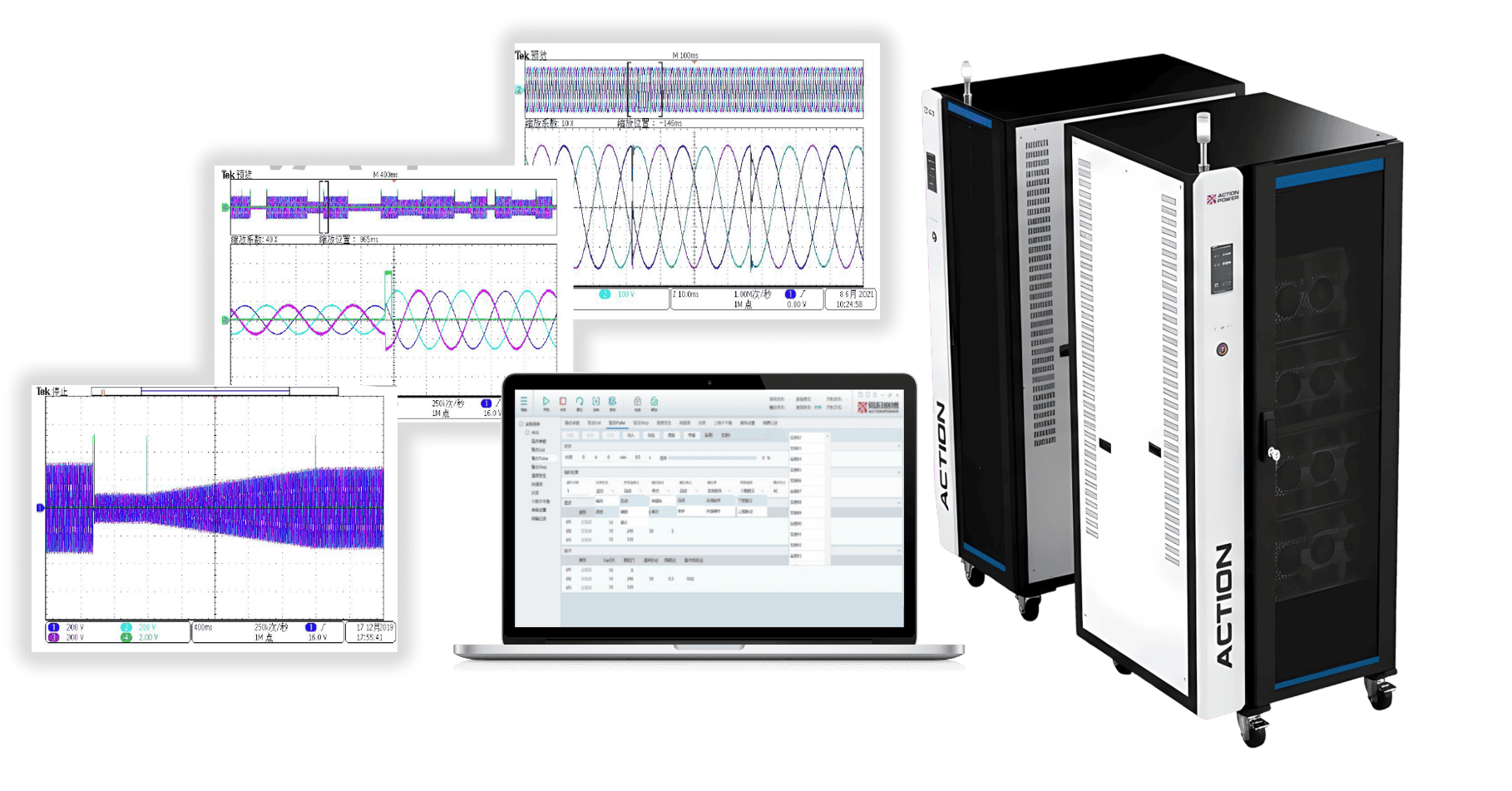

3U/22kVA rackmount AC power supply and a four-quadrant regenerative grid simulator, ideally for in-laboratory deployment and testing against components level grid code compliance testing.

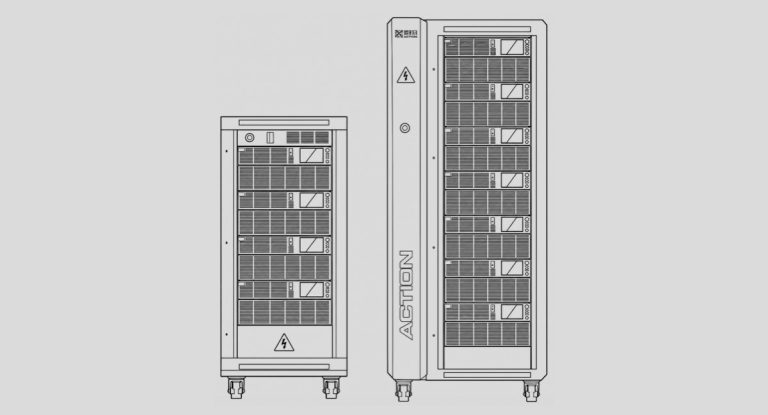
Specification-matching testing and simulation solutions need discussion of both parties. Actionpower welcomes you inquiry to study together with us about how we can automate your testing processes.
Send InquiryThese are the upcoming events and places you can find ACTIONPOWER and talk with us face-to-face!
Check EventsAccess our Power Supply Wizard to find the right programmable power supply for your use cases and testing scenarios.

Professionalism is what we care about. Why not email us with your technical requirements fully explained rather than submitting a simple message so that we revert more proactively with detailed solutions?