Application Use Jun 23, 2026
How to Conduct Server Workload Testing against BBU?
BBU assumes the critical role of sustaining the AI server date center during utility outage or any unexpected...
Discover ActionPower's experience in the field of power electronics throughout 30 years of growth and successful track of industrial solutions.

Explore ActionPower's comprehensive range of programmable power and automated testing equipment covering AC/DC, profile emulation and testing sequence automation.

ActionPower combines our advanced programmable power with sophisticated softwares for diverse profile emulation solutions as well as versatile functioning realization.

ActionPower supports technological advancement for our users from various industries with flexible, sophisticated and multi-functional programmable power systems and profile emulation solutions.


AI Data Center TestingGrid Emulation SolutionsGet in Contact

Primary power components like power supply units (PSUs) and Voltage Regulator Modules (VRMs), along with power subsystems such as uninterruptible power supply (UPS) and battery backup unit (BBU), are both the functional and infrastructural grouding on which AI servers may operate and process data stably, resiliently, and without failling or shutdown. In another word, the reliably operation of AI servers is dependent on how stable these power subsystems and power components function.

From the DC side of AI server, worldload of GPU cluster is subject to suddent processing demand upsurge that drives current draw up which in turn causes the voltage sags. Similarly, a workload halt may either lead to a voltage spike. Repectively for power components which functions the voltage source they have to align with such operational patterns for safe and stable operations of downstrem server components.
Although the utility-connected AC side of the system is typically regulated by transformers or uninterruptible power supplies (UPS), it remains susceptible to external grid disturbances. For instance, a grid outage necessitates a transition from grid-supplied power to Battery Backup Unit (BBU) operation. Furthermore, in data centers utilizing integrated hybrid Energy Storage Systems (ESS), seamlessly transitioning into an islanded microgrid requires the power subsystem to possess robust fault-tripping and dynamic switching capabilities.

The underlying concern is that, while the aforementioned events may cause transient changes in the power profile, it remains unclear how these power subsystems and components can be validated for their resilience against such disturbances.
Named after the Information Technology Industry Council (ITIC), the ITIC curve defines the acceptable voltage tolerance envelope for IT equipment by plotting percentage voltage variations against time duration. ITIC curve guides hardware engineers in designing robust power supply units (PSUs) capable of handling the rigorous and continuous demands of AI computing.
Define the fundamental parameters of voltage tolerance testing
The ITIC curve evaluates power resilience by mapping events across two fundamental dimensions. The Vertical Axis represents the disturbance magnitude as a percentage of the nominal voltage (typically ranging from 0% to 500%). The Horizontal Axis tracks the duration of the event on a logarithmic scale, from rapid 1-microsecond transients to continuous steady-state conditions. Together, these axes delineate three distinct equipment response domains.
The target voltage envelope for continuous, uninterrupted AI computing
This central envelope defines the standard ride-through capabilities required for IT equipment. When power disturbances fall within this domain, components like PSUs and PDUs must regulate the voltage effectively, ensuring the AI server continues to operate seamlessly. Staying within this safe zone guarantees that intense DC workloads remain unaffected by grid sags or surges without triggering system resets.
Undervoltage zones where service interrupts, but hardware is protected
Located below the acceptable operating envelope, this region characterizes severe voltage sags or deep brownouts (e.g., dropping to 0% for longer than 20ms). If a disturbance enters this area, the power subsystems will lack sufficient input to sustain the AI computing workload, resulting in a safe system shutdown or reboot. However, the curve guarantees that the hardware itself will not sustain any physical or electrical damage.
Severe overvoltage transients risking permanent hardware failure
Situated at the upper extremes of the curve, this boundary defines dangerous overvoltage surges and spikes. Exposure to the prohibited zone exceeds the dielectric and thermal safety limits of the server's power nodes. Equipment must never be subjected to these conditions, as they pose a severe risk of catastrophic component failure, insulation breakdown, or permanent degradation of the AI infrastructure.


Engineered for facility-level AI data center validation, the TITAN high-power grid simulator effortlessly replicates extreme ITIC voltage sags and surges. It delivers the immense power capacity required to stress-test fully populated AI server racks and integrated microgrids during profound AC grid disturbances.
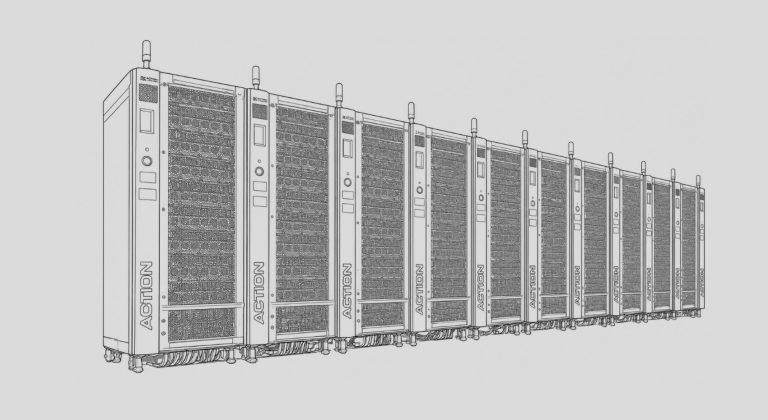
A high-power-density, modular cabinet system designed for scalable ITIC compliance testing. Easily reconfigure your test bench by swapping modules to match the specific power envelopes of various AI computing architectures, ensuring robust AC fault ride-through simulation.
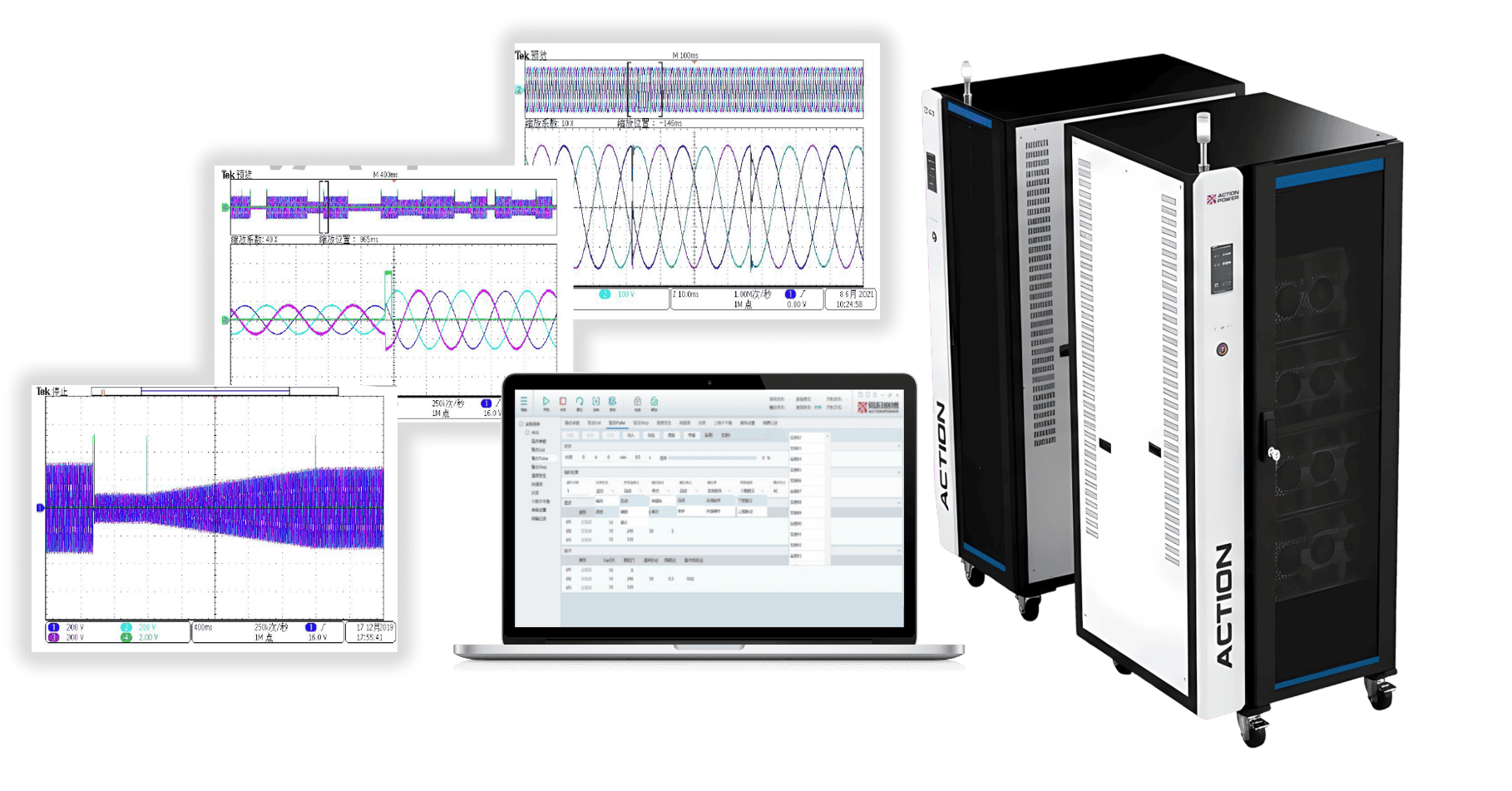

A highly responsive 3U/22kVA regenerative grid simulator perfect for precise in-lab ITIC validation. Its rapid slew rate and dynamic programming control make it ideal for pinpointing the operational boundaries of individual AI server PSUs, PDUs, and BBUs under microsecond AC transients.

Specification-matching testing and simulation solutions need discussion of both parties. Actionpower welcomes you inquiry to study together with us about how we can automate your testing processes.
Send InquiryThese are the upcoming events and places you can find ACTIONPOWER and talk with us face-to-face!
Check EventsAccess our Power Supply Wizard to find the right programmable power supply for your use cases and testing scenarios.

Professionalism is what we care about. Why not email us with your technical requirements fully explained rather than submitting a simple message so that we revert more proactively with detailed solutions?