Home Contact EN

How to Test E-Mobility Vehicle Battery Pack

Programmable power and ATEs for dynamic EV battery charge and discharge operation emulation

More about EV Testing Solutions   Get in Contact

Controllable Dynamic Operation Status

EV Battery Pack Performance Test with Programmable Power


e mobility vehicle battery performance testing topology
In real-world electric vehicle applications, a battery pack does not operate under simple or steady charge-discharge conditions. Instead, it continuously experiences dynamic load fluctuations, regenerative braking energy feedback, fast-charging transients, and complex thermal management coupling. Therefore, battery pack testing must rely on high-precision, fast-response power electronic systems to realistically emulate current pulses, power steps, SOC dynamics, and long-term cycling behaviour under vehicle-level operating scenarios. This involves not only accurate bidirectional energy flow control, but also comprehensive validation of voltage and current ripple, transient response speed, and protection strategies to ensure the battery system meets vehicle-grade requirements in safety, durability, and consistency.
Advanced battery testing systems adopt a programmable bidirectional power architecture to enable fully configurable charge and discharge profiles, including voltage, current, power, slew rate, timing sequences, and cycling logic. They support CC (constant current), CV (constant voltage), CP (constant power), and hybrid operating modes with flexible test scripting. The supervisory software allows engineers to create and manage test sequences, monitor real-time data, perform curve analysis, and automatically generate reports, while supporting multi-channel parallel control and grouping management. At the system integration level, communication interfaces such as CAN, CAN FD, RS485, or Ethernet enable seamless integration with the BMS, allowing real-time data acquisition and protection coordination for closed-loop control and fault simulation. The platform can also integrate environmental chambers, cooling systems, and safety interlocks, forming a highly repeatable and traceable battery pack validation environment.
cabinet power supply and ATE system for battery cycling

Validate high-power EV battery with profile emulation and programmable power

Advanced Battery Pack Testing Equipment


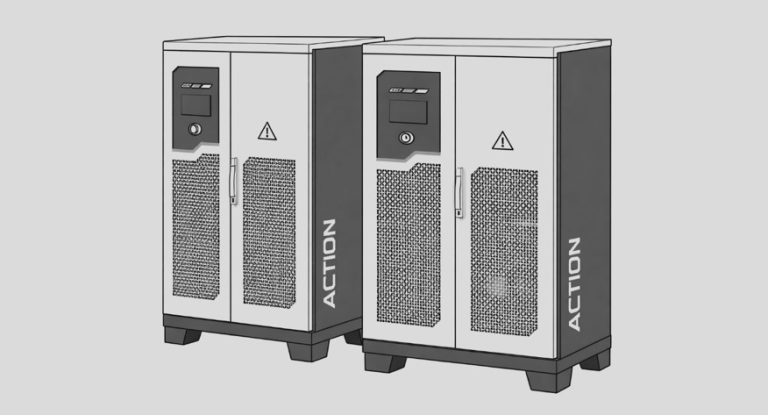
Comprehensive validation of high-power EV battery packs requires realistic emulation of dynamic vehicle operating conditions. ActionPower’s EV battery pack test solution supports battery development and validation with scalable architecture, delivering up to 300 kW per cabinet and voltages up to 1500 V, with MW-level expansion capability. Based on high-voltage SiC technology and regenerative design, the system ensures high efficiency, compact footprint, and reduced operating costs.

Technical Advantages


Dynamic Profile Emulation

0.02% F.S. accuracy and response times as fast as 4 ms, real simulation of current and power transients under extreme vehicle start–stop conditions to ensure reliable battery validation and development.

Beyond reality ev battery pack profile emulation

Flexible Control Interface

Supports custom protocol configuration for Modbus, SCPI, and CAN communication, enabling seamless integration with third-party equipment such as thermal chambers, chillers, and BMS through value mapping, extended commands, and variable mapping.

battery profiling modeling of actionpower software

Flexible System Upscaling

Flexible upscaling options including dual-channel parallel operation within a single cabinet and multi-unit parallel configuration, enabling current and power expansion to enhance overall output capability.

                       scalable EV battery operation testing system

Four-Quadrant & Regenerative

Over 93% energy regeneration efficiency during battery discharge testing, feeding energy back to the grid instead of dissipating it as heat—reducing facility power consumption, lowering cooling requirements。

grid feed back energy recovery

E-Mobility Battery Testing Hardware

battery cycling testbench ATE power supply

BTS is a high-precision, modular battery cycler automated testing system covering traction battery pack testing for EV and battery pack for ESS applications. With bidirectional charge/discharge, automated test cycles, and Power-HIL architecture, it simulates real driving profiles, regenerative braking, and fault conditions—without physical vehicle hardware—supporting R&D, verification, and production testing.

Key Features

  • Scalable multi-channel architecture for cell, module, and pack testing
  • Unified control interface for parallel and series test management
  • Power-HIL integration with BMS, thermal chambers, and cooling systems
  • Dynamic simulation of EV driving and transient operating conditions
  • Automated compliance-ready test reports

Check Battery Cycler ATE

Frequently Asked Questions About EV Battery Testing

› Why is battery testing critical for e-mobility vehicles?
E-mobility vehicle batteries operate under highly dynamic conditions, including rapid acceleration, regenerative braking, fast charging, and extreme temperatures. These scenarios introduce fast current transients and bidirectional power flow that directly affect safety, performance, and lifetime. Comprehensive testing ensures electrical integrity, validates BMS protection strategies, and guarantees reliable operation under real-world driving conditions.
› What operating scenarios should be simulated during battery testing?
A complete test strategy should emulate dynamic drive cycles, regenerative braking events, fast charging, high-power discharge, start–stop transients, and fault conditions such as over-voltage or communication interruptions. Simulating these scenarios enables validation of battery response, system stability, and protection coordination before vehicle integration.
› What key parameters determine battery performance?
Key performance indicators include State of Charge (SoC), State of Health (SoH), Depth of Discharge (DoD), DC Internal Resistance (DCIR), charge/discharge efficiency, and transient voltage and current response. High-precision measurement of these parameters helps characterize dynamic behavior, aging trends, and overall reliability.
› How can a programmable test system replicate real vehicle conditions?
A programmable bidirectional power system precisely controls voltage, current, power, and slew rate to reproduce complex drive cycles and charging profiles. Supporting CC, CV, CP, and dynamic waveform modes, it enables realistic load emulation. Integration with BMS via CAN, Modbus, or Ethernet allows closed-loop control, real-time data acquisition, and fault injection testing.
› How can battery testing costs and energy consumption be reduced?
Regenerative test systems feed discharge energy back to the grid instead of dissipating it as heat, significantly reducing cooling demand and facility energy consumption. Modular and scalable architectures also enable flexible current and power expansion, lowering infrastructure investment while supporting both R&D and production testing.

Inquire Your Solutions for EV Battery Test

Product Inquiry

Specification-matching testing and simulation solutions need discussion of both parties. Actionpower welcomes you inquiry to study together with us about how we can automate your testing processes.

Send Inquiry

Trade Shows & Events

These are the upcoming events and places you can find ACTIONPOWER and talk with us face-to-face!

Check Events
Social Media

Follow us to keep updated of our innovations.

LinkedInTwitter
Quick Model Access

Smart Discovery

Access our Power Supply Wizard to find the right programmable power supply for your use cases and testing scenarios.

discover programmable power supply by filtering with current, voltage and power ranges
CONTACT US

Contact Us

Professionalism is what we care about. Why not email us with your technical requirements fully explained rather than submitting a simple message so that we revert more proactively with detailed solutions?

Subscribe to Newsletter

Thank you for subscribing!