


Grid Code Compliance Test with MVA Power Grid Simulators: Testing Platform Build-Up and Model Options

Excelling the industry of power testing with our high-power programmable systems including grid simulators and battery simulators, ActionPower has had a range of successful stories with certification institutes and energy storage system manufacturers for building high-power MW and MVA level testing platforms for validating grid code compliance of devices including power conversion systems (PCS), grid-following and grid-forming inverters, as well as hybrid systems.
While during your visit to our website for identifying the right system for your testing platform and it seems confusing now that most of our AC power system are inherently grid simulators, we have here for your this specific application note to support your decision-making for building up a MW and MVA testing platform with a comprehensive deployment analysis based on power rating, space utilization, flexibility, and scalability.
| Version | 1.0.0 |
|---|---|
| Categories | Megawatt Power Testing |
| Download | Download Application Note |
| Download Count | 9 |
| Page Views | 843 |
| Size | 945.53 KB |
| Create Date | 04/04/2026 |
| Last Updated | 04/11/2026 |
| Author | Zhiwei Bao |
| Reviewed | Sen Wang |
Cost is just the seemingly primary factor for your procurement of megawatt and megavolt-ampere testing platform when building a certification and testing facility, however, what come after and actually override the former are the flexibility of deployment, space utilization and power density, and future-proof scalability – if you don’t expect that this is only an ad-hoc implementation which should be totally replaced once when testing requirements and applications vary or evolve.
The questions are far more complex when it comes to grid code compliance testing, especially where EUTs like power conversion system (PCS) and grid-forming inverters are usually of high-power ranging from hundreds of kW, then typically ranging up from 1 MW to 10 MW. (e.g., Tesla Megapack 2XL, SMA Sunny Central Storage UP, Sungrow PowerTitan 3.0, and Power Electronics HEM series) [1]
We don’t spend too much efforts on what are the testing standards and guidelines applied, as another application note has talked about IEEE 1547.1 and UL 1741, however, in this application note we focus about the hardware part, that is to say:
- How would you benefit from a high power-density grid simulator for testing application
- The tremendous potential savings with a reconstructible and re-buildable system (ActionPower’s NEXUS module-based cabinet system)
- High-fidelity and flexibility, improved space utilization and flexible system architect optimization brought be flexible high-power grid simulators
Sure that you are still confusing? Reading ahead and you should figure out what we would like to address with above points.
Importance of MW & MVA Platforms in Grid Code Testing
Utility-scale renewable energy systems such as energy storage systems, and PCS or inverters either functioning as grid-forming and grid-following ones, have their power rating typically covering a range of 2.5 ~ 3.45 MW. Nevertheless, evolving power capability is an inevitable trend given the sustainability goals pursuing which renewable energy is expected to be a primary source.
Central inverters are typically heading for power beyond 5 MW, meanwhile that grid forming inverters are witnessing their growing presence in the new energy landscape. While 1+ MW tests were historically focused on Grid-Following (GFL), the shift toward weak grids requires MW-scale grid-forming inverters to provide short-circuit current support (often 1 to 3 times of overload), placing higher transient demands on test platform or benches. [2]
Consequently, establishing a MW or MVA-level testing platform is no longer just about meeting high-power load requirements; it is a strategic necessity for elevating validation from isolated functional checks to comprehensive, system-level performance emulation.
Scaling to 6 MVA: Module-Based Grid Simulator Cabinets
A grid simulator built on module-based cabinet system like PRO20 programmable power supply or NEXUS AC Programmable Power Supply offers both scalability from within the cabinet and for between the cabinet by parallel connection. Read one of our past application notes of “Form Factor and Structural Design of Programmable Power: Pros and Cons Analyzed for Rackmount, Module-Based Cabinet, and Tower Type Systems” where you will find detailed explanation.
Baseline Deployment: 400 kVA to 750 kVA Cabinets
Taking PRO20 AC Programmable Power Supply for example which featured by its advanced programming capability is also in nature a regenerative grid simulator.
A single cabinet of PRO20 can either be built with a single rack consisting of 8 power modules reaching up to 400 kVA, while an additional option is to integrate a sub-cabinet for forming a master-slave integrated cabinet, achieving power of 750 kVA (While the primary rack has 8 modules, the subsidiary one comes with 7, with 1 missing due to wring required for parallel connection.)
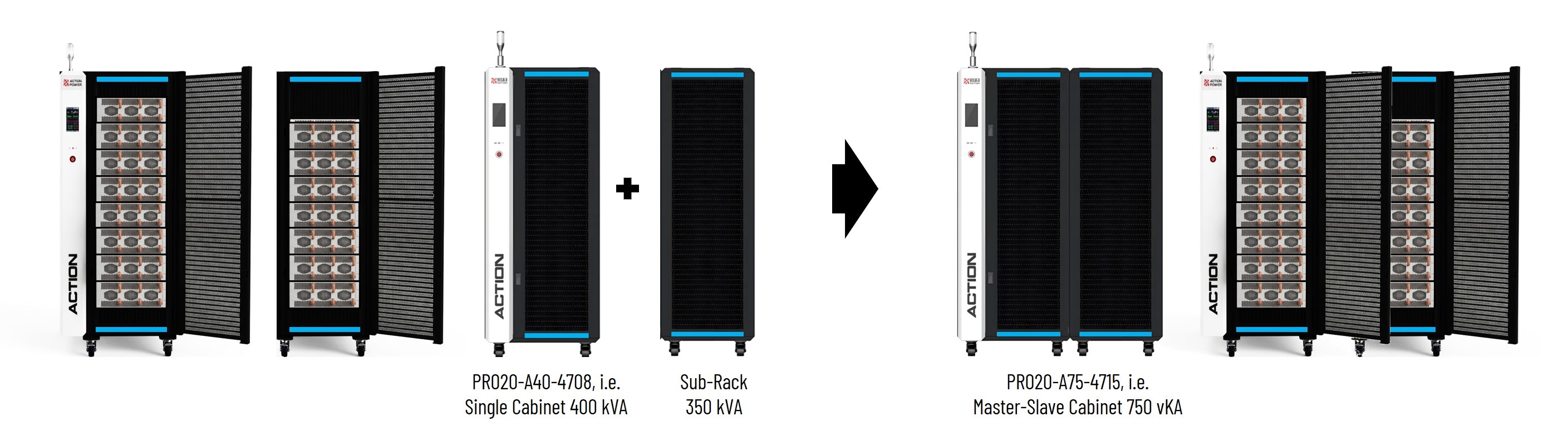
Fig 1. Master Cabinet and Sub-Rack (Slave Cabinet) Combined to Reach a 750 kVA High-Power Cabinet
- The former deployment of 400 kVA comes with a dimension (L*W*H) of 800*1000*1950mm, equivalent to a measurement of 1.56 /(m3, standing for a power density of 256 kVA per /(m3 and for space utilization the power density is 500 kVA per /(m2
- The latter with 750 kVA features a dimension of (L*W*H) of 1400*1000*1950mm, equivalent to a measurement of 2.73 /(m3, standing for a power density of 274 kVA per /(m3 or 536 kVA per /(m2

Fig 2. Power Density per Square or Cubic Meter
Rapid Expansion via Parallel Cabinet Connections
The PRO20 programmable AC power supply is architected with option of flexible parallel connection between same models, so that you can start with a single cabinet (either with our without a sub-rack) and then scale up by adding more units in parallel, without changing your overall test architecture, turning a standalone source/load into a multi‑megawatt grid simulation and code compliance testing system.
- Use a single cabinet as the minimum power building block
Test setup may begin with a 400 kVA single cabinet (for example, PRO20‑A40‑4708) or a 750 kVA master-slave integrated cabinet (PRO20‑A75‑4715) to build a complete bidirectional AC source/load test bench for early functional validation and relatively-lower‑power type testing.
- Scale via integrated parallel connection kits
For matching evolving power rating for example should you set a multi-workstation platform or that the PCS to be tested exceeds until MW power level, equip the target cabinets with the parallel connection kit (referred to PRO‑A0001) and add the required bus-bars or cables on the distribution side. Multiple cabinets then operate in parallel as a single integrated test platform with internal current sharing and protection coordination handled inside the units, so the upper‑level controller still sees one logical device.
- Expand linearly to multi‑megawatt (megavolt-ampere) platforms
With up to 8 units of cabinet (either single unit or master-slave integrated unit) in parallel connection allowed, you may:
- Use 400 kVA single cabinets as building blocks to scale to 800 kVA, 1.2 MVA, 2.0 MVA, and up to about 3.2 MVA.
- Use 750 kVA master-slave cabinets as building blocks to scale to 1.5 MVA, 3 MVA, and up to about 6 MVA, meeting grid emulation and regenerative load test requirements for PV inverter, BESS converters, and microgrid applications.
Space Utilization & Footprint Analysis for 6 MVA Platforms
Eventually you should have understood how a module-based based system of grid simulator scales up by stacking modules until parallelling between cabinets. The below charts should clearly visualize the system you will have set up and respectively how much space they take for your laboratory.
| Stage / Use Case | Cabinet Rating & Type | No. of Cabinets | Total Power (kVA) | Row Width (m) | Depth (m) | Equipment Footprint (m²) | Area Power Density (kVA/m²) | Notes |
|---|---|---|---|---|---|---|---|---|
| Initial pilot platform | 1 × 750 kVA high‑power cabinet | 1 | 750 | 1.4 | 1.0 | 1.4 | ≈ 536 | Single cabinet, model PRO20‑A75‑4715. |
| 1.5 MVA mid‑size platform | 2 × 750 kVA cabinets in parallel | 2 | 1500 | 2.8 | 1.0 | 2.8 | ≈ 536 | Two cabinets paralleled for medium‑power grid code testing. |
| 3.0 MVA large platform | 4 × 750 kVA cabinets | 4 | 3000 | 5.6 | 1.0 | 5.6 | ≈ 536 | Covers most 3 MW grid code test scenarios. |
| 4.5 MVA extended platform | 6 × 750 kVA cabinets | 6 | 4500 | 8.4 | 1.0 | 8.4 | ≈ 536 | Adding two more cabinets upgrades from 3.0 to 4.5 MVA. |
| 6.0 MVA full platform | 8 × 750 kVA cabinets (max parallel) | 8 | 6000 | 11.2 | 1.0 | 11.2 | ≈ 536 | Uses the 8‑cabinet parallel limit to form a single 6 MVA test platform. |

Fig 3. Footprint and Power Density of 6 MVA Grid Code Testing Platform
Scaling to 10 MVA with TITAN Tower-Type Grid Simulators
While the a platform scales impressively to 6 MVA – covering most central PV inverters (1–5 MW), onshore wind, and MW-scale BESS for standard grid code type tests – emerging assets like 10–15 MW offshore wind turbines and large central inverters demand more. Modern grid codes also require full-power dynamic testing (FRT, ramping, grid-forming), where 6 MVA forces down-rating or extrapolation that doesn’t fully replicate real grid conditions.
For setting up a platform beyond 6 MVA, ActionPower’s TITAN Grid Simulator should be an alternative option with capability of scaling up from a single cabinet covering 350 kVA to 1 MVA and further reaching 10 MVA maximum power by parallel connection, which is an ideal power capability for validating next-generation 8~10 MW converters, offshore wind, utility-scale PV+BESS systems and setting your lab correspondingly for their application.
There should be some additional trade-offs to bear in mind, once you are considering scaling up further beyond the capability of module-based cabinet system.
TITAN Series: Single Cabinet Power Capabilities
A single cabinet of TITAN Grid Simulator, with different model options, covers power rating from 350 kVA until 750 kVA and 1 MVA. For instance,
- TA500-576-05 is of a footprint of 2410*1400*1955 mm, offering a maximum power of 500 kVA, correspondingly standing for power density of 75.8 kVA per m3\) and 148.2 kVA per m2\)
- TA1K0-700-10 with 1 MVA as the highest power model among TITAN series, measured with dimension of 3410*1400*1955 mm, offering power density of 107.1 kVA per per m3\) and 209.5 kVA per m2\)

Fig 4. Power Density per Square or Cubic Meter of TITAN Grid Simulator
Space Utilization & Footprint Analysis for 10 MVA Platforms with TITAN
One of our past technical article introduces how tower-type cabinet system as TITAN can uncompromisingly achieve ultimate MVA power while offering the same dynamics and responses as if a single unit. Read that article in case you have missed the technical explanation. The chart below gets you an overview of upscaling options with TITAN.
| Stage / Use Case | Cabinet Rating & Type | No. of Cabinets | Total Power (kVA) | Row Width (m) | Depth (m) | Equipment Footprint (m²) | Area Power Density (kVA/m²) | Notes |
|---|---|---|---|---|---|---|---|---|
| Single TA500 cabinet | 1 × 500 kVA TA500-576-05 | 1 | 500 | 2.41 | 1.40 | 3.37 | 148.2 | Single TITAN cabinet, footprint 2410×1400×1955 mm, power density 75.8 kVA/m³ and 148.2 kVA/m². |
| Single TA1K0 cabinet | 1 × 1000 kVA TA1K0-700-10 | 1 | 1000 | 3.41 | 1.40 | 4.77 | 209.5 | Highest-power single cabinet in TITAN series, footprint 3410×1400×1955 mm, power density 107.1 kVA/m³ and 209.5 kVA/m². |
| 1.0 MVA compact platform | 2 × 500 kVA TA500 cabinets in parallel | 2 | 1000 | 4.82 | 1.40 | 6.75 | 148.2 | Two TA500 cabinets in parallel, maintaining the same single-cabinet area density. |
| 2.0 MVA compact platform | 2 × 1000 kVA TA1K0 cabinets in parallel | 2 | 2000 | 6.82 | 1.40 | 9.55 | 209.5 | Two TA1K0 cabinets in parallel, offering higher TITAN platform density. |
| 3.0 MVA medium platform | 3 × 1000 kVA TA1K0 cabinets in parallel | 3 | 3000 | 10.23 | 1.40 | 14.32 | 209.5 | Three TA1K0 cabinets paralleled for medium-power grid test scenarios. |
| 5.0 MVA large platform | 5 × 1000 kVA TA1K0 cabinets | 5 | 5000 | 17.05 | 1.40 | 23.87 | 209.5 | Five TA1K0 cabinets provide efficient large-scale TITAN expansion. |
| 6.0 MVA platform | 6 × 1000 kVA TA1K0 cabinets in parallel | 6 | 6000 | 20.46 | 1.40 | 28.64 | 209.5 | Full parallel configuration using 1 MVA single cabinets. |
| 10.0 MVA extended platform | 10 × 1000 kVA TA1K0 cabinets in parallel | 10 | 10000 | 34.10 | 1.40 | 47.74 | 209.5 | Scaled TITAN platform to 10 MVA using 1 MVA cabinet architecture. |

Fig 5. 6 MVA and 10 MVA Grid Compliance Testing with TITAN
Decision Making Suggestions, Compare and Contrast of MVA Testing Platform Setup
System architecture options require a prudent trade-off with plenty of factors other than the specifications and performance to concern, however, they will also affect your space utilization efficiency, scalability flexibility in case some day in the future you want rebuild your test facility, then come considerations around your floor loading capability and deployment locations (ground vs. upper floors). Below we compare the 2 options of models when building MVA grid code testing platforms from different points of views by charts.
Footprint Comparison: PRO20 vs. TITAN Series
| Power Level | PRO20 Footprint | TITAN Footprint | Space Savings |
|---|---|---|---|
| 0.75-1.0 MVA | 1.4-2.8 m² | 3.37-4.77 m² (single cabinet) | PRO20: 40-60% smaller |
| 3.0 MVA | 5.6 m² (4×750kVA) | 14.32 m² (3×TA1K0) | PRO20: 61% smaller |
| 6.0 MVA | 11.2 m² (8×750kVA) | 28.64 m² (6×TA1K0) | PRO20: 61% smaller |
Key Insight: PRO20 achieves higher system-level density (357-536 kVA/m²) through optimized multi-cabinet layouts, while TITAN excels in single-unit density (209.5 kVA/m² for TA1K0)
System Scalability and Deployment Flexibility
| Aspect | PRO20 Series | TITAN Series |
|---|---|---|
| Upgrade Path | Modular: Internal module replacement + master-slave paralleling | Whole Cabinet: Full cabinet-to-cabinet paralleling |
| Granularity | Fine-grained (2.73 m³ single cabinet) | Coarse-grained (9.33 m³ indivisible units) |
| Future-Proofing | High – upgrade power without moving cabinets | Medium – requires physical cabinet relocation |
| Redundancy | N+1 module-level redundancy | N+1 system-level redundancy |
Key Insight: Both system provides possibility of system re-composition by re-arrange your parallel connection among the existing cabinets. For example, splitting the 10 MVA system into 2 separate ones of 3 MVA and 7 MVA is possible with TITAN. Module-based cabinet system offers finer reconstruction thanks to finer power rating of each module (50 KVA). Both system avoids the complete replacement of a testing platform or repurchasing of an additional one.
Physical Loading & Power Density Metrics
| Parameter | PRO20-A75-4715 | TA1K0-700-10 |
|---|---|---|
| Weight | 1,745 kg | 5,810 kg |
| Footprint | 1.4 m² | 4.77 m² |
| Weight/m² | 1,246 kg/m² | 1,218 kg/m² |
| Floor Impact | Distributed across smaller area | Concentrated point loading |
Recommendation: Always consult structural engineer. Verify concentrated load capacity and punching shear before upper-floor deployment.
Consult ActionPower’s FAE Team for MVA Testing Solutions
Still feel uncertain what to opt for and which model fits better your application of high-power grid code compliance testing? Choosing between a high-density Tower Type architecture and the versatile Module-Based Cabinet System involves critical trade-offs in footprint, space utilization, potential future evolving demands and transient response capabilities.
Contact ActionPower’s FAE and Sales Team for a deep-dive technical consultation. Let us help you navigate the complexities of MVA-level testing to ensure your platform is optimized for the grid-forming challenges of tomorrow.
Bibliography
- [1] Tesla Megapack 2XL, Megapack Large-Scale Energy Storage, Tesla, Link
- [2] GC0137: Minimum Specification Required for Provision of GB Grid Forming (GBGF) Capability (formerly Virtual Synchronous Machine/VSM Capability), National Grid ESO, Link

About the Author
Zhiwei Bao
Zhiwei Bao holds 20+ patents in the field of mechanical engineering and is keen on industrial automation and product marketing. His interdisciplinary background, along with his passion and initiative for learning, has led him to a profound understanding of power electronics. He manages the technical copywriting for programmable power and testing topics at ActionPower through product-marketing-driven approaches.
About Zhiwei Bao